Tuesday, October 18, 2022

To Live and Die in Haddonfield

Unlike fellow slasher franchises Friday the 13th and A Nightmare on Elm StreetHalloween has never had an entry up till now that explicitly billed itself as the "final chapter." Even H20 wasn't promoted that way, which is why even the sight of Jamie Lee Curtis lopping off Michael's head in that film didn't convince anyone that Halloween was over. As much as it looked final, no one was buying it. Even a close-up of Michael's severed head lying on the ground was met with the unanimous reaction of "Eh, he'll be back." 
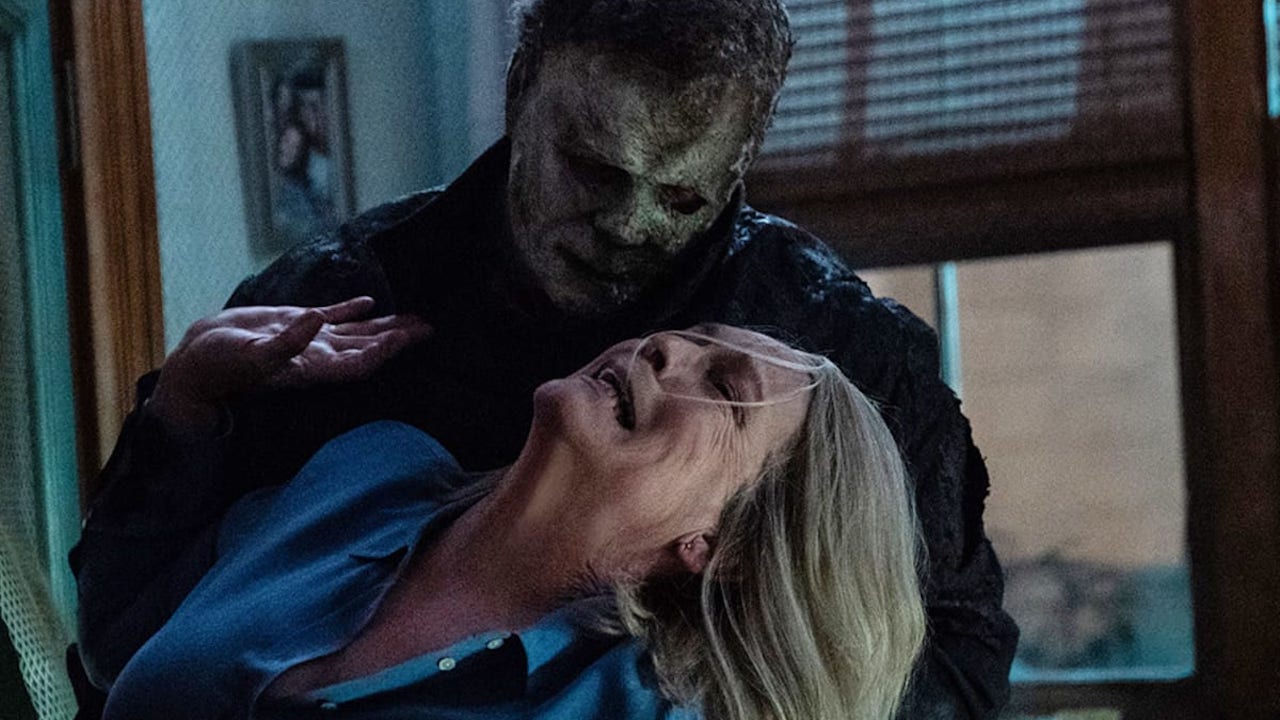
Halloween Ends, though, makes the most forceful, most unambiguous statement it can that, for real, this is it. As the first Halloween to promise to end Michael Myers once and for all, Ends lives up to its title, providing arguably the most definitive death of any major slasher icon. Michael ain't getting up from this one. He is fucking done, people. You know, at least until the next Halloween.

Yes, as dead as Michael is here, there will be more Halloweens and more of Michael Myers. This is such a certainty that it's ridiculous to pretend otherwise. It doesn't matter whether Ends is a hit or a bomb, that's not going to affect anything. Bottom line is that the rights holders are always going to be looking to exploit this iconic property. Wondering whether or not the Akkad family is going to make more Halloween movies is like wondering whether the Broccoli family will ever get tired of producing Bond films. Franchises like this are eternal so it's just a matter of time before Michael hits the streets of Haddonfield again. 

There is no deception, however, about whether Ends is closing the book on this particular chapter of the series. It is, it does and it does not cop out on that one bit. To its credit, Ends doesn't even offer a last minute wink to the audience to let them know that, oh, it's not really over. This is not like Friday the 13th: The Final Chapter where the final moments of that film revealed the title to be a cynical joke all along. No, director David Gordon Green brings his trilogy to an authentic, sincere, no fooling conclusion here. All it's really ending, though, is Laurie Strode's journey. It's just that Michael has to die (at least in this timeline) for Laurie to move on. As long as the audience believes there's even the slimmest of chances that Michael Myers might return on some other October 31st to come, even if it's when both of these characters are in their 90's, no one is going to feel that Laurie is truly free and clear.

So that's what Halloween Ends gives us: true closure. That alone gives it a special distinction among horror franchises, which are defined by their open ended nature. Unlike Laurie's lackluster previous "final" appearance in 2002's Halloween: Resurrection, this represents a much more fitting farewell for her. No matter what people may think about Ends as a whole, everyone will be able to agree that it leaves no unfinished business for Laurie. Her life when the end credits roll on this is now 100% boogeyman free. 

The immediate reaction to Ends has been split between "It's weird, I hate it" and "It's weird, I love it!" You can put me in the latter camp but I do sympathize with the former. This is the series' most defiantly oddball entry since Season of the Witch (whose blue title font is used here, giving an early indication that this will be a Halloween entry that's willing to throw a curve ball to the fanbase) and I commend director David Gordon Green and his Ends co-writers Paul Brad Logan, Chris Bernier, and Danny McBride, for not paying any mind to expectations. In a pop culture environment where there is often an overriding impulse to play it safe and just give the audience what they want, there is something wonderfully refreshing about a movie that is so unconcerned with that. Whatever you might think of Ends, you can't say they didn't put a premium on the creative process. This trilogy has been Green and co.'s chance to play in the sandbox of a franchise that they clearly love and I appreciate that they just fucking ran with it.   

There's a time jump of several years here so we get no direct follow up to the ending of Kills. Laurie's daughter Karen (Judy Greer) was murdered at the end of that film but we don't see the immediate aftermath of that. When we do catch up with present day Laurie, she's moved on as best she can. She's in the best place mentally that we've seen her in since the new trilogy began. As opposed to the grim, obsessed hard case she was in 2018's Halloween and Kills, she's more of a wacky grandma now. She's living in a new house with her granddaughter Allyson (Andi Matichak) and their place is located in the middle of Haddonfield, rather than being a fortified fortress in the middle of nowhere. Laurie is also writing a memoir about her survivor's story and Michael has neither reared his head nor (as far as anyone knows) plunged his butcher knife into anyone since that bloody Halloween night in 2018. 

He is still around, though, just living a less glamorous life in Haddonfield's sewer system. No more fancy mental institutions for this guy. Whether it's due to age, injury or just a simple lack of get up and go, the mass slaughter days of old are over for Mad Mike (to be fair, after the body count he racked up in Kills he's earned the right to kick back). But when Corey Cunningham (Rohan Campbell), a young man who had been involved in the accidental death of the boy he was babysitting on Halloween night in 2019, finds himself within Michael's reach after an encounter with some local bullies leaves Corey lying close to Michael's lair, a strange partnership is formed. Rather than killing Corey after dragging him into the drain pipe entrance to his present digs, Michael, through some kind of psychic bond, taps into the darkness inside of Corey and vice versa. Michael lets Corey go but some of Michael's essence goes with him. Complicating matters is the fact that prior to Corey and Michael making their connection, Laurie had introduced Corey to Allyson and a romance between the two immediately sparked. 

I imagine there could have been a more conventional version of Ends that would have checked off most of the boxes for fans but this isn't it. Rather than Laurie turning Haddonfield inside out on the hunt for Michael (a move that would only have undermined the emotional growth that Laurie has experienced and prove that she learned absolutely nothing from the previous two films) or Michael actively pursuing Laurie (which would make no sense as this trilogy has established that Michael does not care about Laurie whatsoever or even possess an understanding of who she is), we get a movie where Michael's evil insidiously creeps back into Laurie's life as she senses Michael's darkness lurking inside this unassuming boy that her granddaughter is dating. I know this has some fans all up in arms but I dig it. A coming of age romance with twisted undertones isn't the usual Halloween fare but it works for me. Allyson and Corey both have a burning resentment towards the town that they feel has wronged them or has stolen something from them and the grievances they share and their resentment towards Haddonfield draws them together, even though Allyson is unaware of the dark path that Corey is on. Is she going to save him? Is he going to pull her deeper into his darkness? There's a real sense of unpredictability when it comes to Allyson and Corey's relationship. Things could go several different ways. It doesn't seem completely impossible that Allyson, troubled in her own way as she is, could get on board with where Corey's going rather than run the other way. 

For his part, Corey is torn between his feelings for Allyson and the addictive sense of empowerment that feeding off/teaming up with Michael gives him. Like the character of Arnie Cunningham from Christine (the King novel and its John Carpenter adaptation) that Corey shares a surname with, his exposure to Michael has brought a new sense of confidence and a cool but sinister swagger to this previously awkward and shy guy who was used to being pushed around by the scary toughs of the local high school marching band (I find this to be a truly great touch in that it really shows just how pathetic Corey's life is - he lives in fear of fucking band kids). The people of Haddonfield were by and large not kind to Corey after the 2019 incident, making him into the town's new boogeyman in the wake of Michael's disappearance, and so siphoning off Michael's power (if in fact that's what's happening as whatever transference is taking place between Corey and Michael is so ambiguously stated that it's hard to define) is a way to strike back at the town that has treated him like a pariah. Whereas the rampages Michael went on in Halloween '18 and Kills were ones where generally random innocents were the victims, Ends plays out as a full on revenge spree with Corey taking out the most deserving douchebags of Haddonfield. As opposed to Michael, where no matter how brutally he's hacking someone up, you never sense his pulse rate rises, Corey is all rage, delivering some of the nastiest kills of the series.

When you have a slasher series that has reached double digit installments, the question you need to ask yourself is "why am I still watching this?" If you're just hanging in there because you're still hoping to finally see them make a perfect Xerox of the original, call it a day and move on. Especially with Halloween, a series that from the jump has gone in so many different directions, nearly all of which have violated the spirit of the original. For all the various branching timelines of the Halloween series, the only timeline that actually means anything when it comes to Halloween is the 91 minute running time of the original. That's it. All you need from Halloween begins and ends there. Everything beyond that is a different kind of ride and what you get out of the other films depends on how much you're willing to roll with the swerves they take. From the start, you had to be prepared to let go of what Halloween was in order to enjoy the films that carried on its name.

Even though its screenplay was penned by Carpenter himself along with the great Debra Hill, 1981's Halloween II was a travesty when it came to staying true to the first movie. It abandoned the original's largely bloodless approach and injected hardcore '80s-style splatter, it swapped out the mystery of Michael Myers' boogeyman nature in exchange for goofy occult nonsense (which only opened the door for more occult nonsense to come), and it torpedoed the randomness of Michael targeting Laurie and her friends in favor of a lazily conceived familial connection straight out of a shitty soap opera. All of these were indefensible, garbage choices. But is Halloween II still a fun slasher movie? Yes, of course! Point is that from early on, it was clear that the Halloween sequels were never going to be what Halloween had been. If anything, they didn't waste any time actively trashing what made Halloween special. So if you're going to appreciate them, you have to just put Halloween aside and judge the rest of the series based on its own separate criteria. 

If someone thinks what Green and co. have done in the new trilogy, and specifically in Ends, is some kind of unprecedented betrayal of Halloween, that just says to me they don't remember what it was like when there was only one Halloween. Michael being Laurie's brother, now that was a betrayal. The first and the worst of them. Nothing else compares. Certainly not the idea of Michael transferring his evil to another person, which is actually pretty standard stuff for the sequels. The whole Thorn trilogy was centered on the idea that Michael's evil could be passed on to someone else. I don't know, if they had the Thorn symbol appear on Corey's wrist, would that have helped some fans wrap their head around this movie? I have to wonder what Halloween films they've been watching that Ends can throw them like it has.


As someone old enough to have watched in real time the unlikely arc of slasher sequels like Friday the 13th: A New Beginning which went from being universally despised only to gain an enthusiastic cult following, I have to roll my eyes at the over the top negativity directed towards Ends. Hate it if you want but I'm telling you, I already know where this train is heading. If anyone thinks the same fandom that still obsessively compares the virtues of two separate, and pretty much equally lousy, versions of The Curse of Michael Myers, won't come to find value in Ends, a movie actually made with real craft and an attention to detail that will reward repeated viewings, I don't know what to tell you. 


Even though we know another Halloween will come along at some point, it might be a long while until we find out when that will be. In the meantime, I'm happy to let Ends sit and be savored. I think fans need to spend some time with this one and let it sink in. I wouldn't say that everything about Green's trilogy landed as well as it could have but I dug the crazy chances and the big swings that Green took across all three films.
 

Above all, these movies performed the much needed service of finally freeing Michael Myers from the tedious task of pursuing his bloodline. Not only did they erase the family connection between Laurie and Michael but this trilogy re-established an aspect of Michael Myers that had been lost since the original, the fact that he is pure, unknowable evil. Whenever he encounters Laurie, it's never about a personal vendetta on his part, it's only because some outside intervention caused it to happen. Even at the end, Michael only goes to Laurie's house because he wants to retrieve his mask from Corey (it's so fitting, even poetic, that this is ultimately what leads to his downfall). That Laurie is there is purely incidental. Michael doesn't attack her because it's Laurie, he attacks her because she's there and nothing more. 

Whether it be the true crime podcasters who naively tried to provoke a reaction from Michael, or Dr. Sartain who thought he could safely study an unleashed Michael, or Laurie who spent years wrongly convinced that Michael must surely be as obsessed with her as she was with him, or the mob who recklessly pursued Michael at the cost of their lives, or Corey who believed he could transform like a black butterfly into Michael's equal, the folly of attempting to understand Michael, or grasp the extent of what he was capable of, was the central element of this trilogy. Over the course of three films, characters underestimate Michael at their own peril and the mistake they all make is that they believe they are dealing with a man. The citizens of Haddonfield preside over Michael's physical destruction at the conclusion of Ends but the mystery of what was inside of him remains intact. What Green and his collaborators understood throughout their time in Haddonfield is that the only sure way to destroy the boogeyman is to try and explain him.  

Wednesday, October 12, 2022

The Heart of Halloween


With Halloween Ends opening this week, Jamie Lee Curtis is set to take her final bow as Laurie Strode. After the wet fart of a death that Laurie suffered in 2002's Halloween: Resurrection, it's been gratifying to see her allowed to craft a more fitting goodbye to the most iconic Final Girl of them all. 


That said, it always slightly chafes me when Curtis is cited as being the heart of Halloween. No disrespect to Curtis but for me, the true heart of Halloween was Donald Pleasence. I love the character of Laurie, I appreciate how Curtis has embodied her over the years but Pleasence as Dr. Loomis was the true stamp of authenticity when it came to Halloween for years and years and the series has never been the same since he passed. 


From the start, Loomis was Michael's hype man. He's the guy who ran the marketing machine for Michael's arrival, coming into town and telling anyone who would listen that Evil was coming ("Death has come to your little town, Sheriff!"). On his own, Michael Myers is kind of whatever. By design he's a bit of a blank slate. It was Loomis describing Michael in the most dramatic terms, as having "the blackest eyes...the devil's eyes," referring to him as "it," as "purely and simply...evil," and setting expectations high for his capacity for violence that elevated Michael into something more than just a dime a dozen thug with a knife. 


There have been a lot of masked maniacs in horror, but Michael Myers is the only one that had Loomis blowing the wind in his sails. Even though in the new trilogy, Laurie kind of adopted the Loomis role when it came to Michael, it just wasn't the same. The Loomis thing didn't come naturally to her. It wasn't even the same when Rob Zombie cast Malcolm McDowell as Loomis, even though on the surface that seemed to be an ideal casting choice. Pleasence brought a brand of eccentricity to Loomis that was unique to him. No one else could impatiently snap at fools in the same satisfying way ("It's your funeral!"). 


Playing Loomis was obviously not challenging work for Pleasence but he always brought his full conviction to it. Over the course of the five Halloween's he was in, watching Pleasence blow up at the various clueless cops, bureaucrats and administrators who didn't comprehend what they were dealing with, no matter how much Loomis explained it to them, was an essential component of the Halloween experience. From one Halloween to another, the routine never changed for Loomis.


Thankfully, no one involved in the sequels ever felt obliged to give Loomis a backstory or tried to fill in the details of his life. You got the vibe that no one in Haddonfield ever bumped into this guy just doing his grocery shopping, you know? He wasn't anybody's neighbor. He was just this driven dude who would come around once a year, always wearing the same set of clothes, and picking up right where he left off. As obsessed with Michael as Laurie might be, she still managed to have a family at least, even if it was a dysfunctional one. You never got that sense with Loomis. You never got any hint of a personal life. It's almost like he just lived for Halloween night, every bit as dormant the rest of the year as Michael himself was.  
 

As cool as it is that Curtis has been able to close the book on Laurie Strode on her own terms, I just wish that Pleasence had been able to do the same. I look at all the fanfare lauded on Curtis and as deserved as it is, it's still a bummer to me that Pleasence never received the same kind of adulation during his lifetime for his contributions to the series. Especially as unlike Curtis, he never left it. Not to begrudge Curtis leaving Halloween behind to pursue superstardom but, character actor that he was, Pleasence kept plugging away as Loomis during those years when it wasn't so fashionable to be in Halloween sequels. Every time out, though, he gave it all he had and the only thing that stopped him from doing more was dying.   

Given Pleasence's precarious health when it came time to film The Curse of Michael Myers, more care should have been put into making sure that movie could serve as a fitting finale for Loomis, if it were to sadly come to that. It's galling that neither the theatrical release or the Producer's Cut of Curse were able to give the character a dignified exit. Whatever intentions the writer had when they wrote the script, once it was clear what condition Pleasence was in, some adjustments should have been made to make sure they weren't pinning a cliffhanger on a frail old man. I don't know if I'd call it a shitty move on the part of the people behind Curse to not take those kind of precautionary measures but it definitely wasn't smart. 

Everyone knows that post Halloween Ends, Michael Myers will be back to slash his way through Haddonfield at some point (I'd place my bets on the 50th anniversary year of 2028). I just hope whatever form Halloween takes in its next incarnation that they try to get a new Loomis in there that can at least come a little closer to being what Pleasence was. Some might say that Curtis will be hard to replace going forward and that they can't imagine Halloween without Laurie but I say Halloween fans already know the series carried on just fine for years without her. Pleasence was the one element that provided a sense of consistency throughout the original timeline and I still say that his absence continues to be felt more profoundly than Curtis' was or will be. So was Donald Pleasence really the heart of Halloween

Yes, as a matter of fact...he was. 

Monday, October 3, 2022

Now The Real Terror Begins: Friday the 13th: The Series at 35


Premiering on October 3rd, 1987, Friday the 13th: The Series was an attempt to milk the successful Friday the 13th franchise further. But while the movie series traded in R-rated splatter with each entry seeing Jason Voorhees adding to his considerable body count, the standards of '80s TV demanded a different approach. Taking its cues (perhaps unintentionally) from the Amicus anthology From Beyond the Grave (1974), Friday the 13th: The Series centered on an antique shop and its cursed inventory. Unlike The Night Stalker, which already strained credibility by its second TV movie by having reporter Carl Kolchack just happen to stumble across another supernatural story (an issue that the Night Stalker-influenced X-Files overcame by having its FBI agents specifically assigned to bizarre, unexplained cases), Friday the 13th: The Series had the perfect set-up with its antique store of cursed items.


As created by Frank Mancuso, Jr. and Larry B. Williams, Friday the 13th: The Series introduced viewers to the owner of Vendredi's Antiques, Lewis Vendredi (played by genre regular R.G. Armstrong), who made a deal with the devil to sell cursed antiques out of his shop. When he tired of being Hell's puppet and tried to break the deal, Satan claimed both Vendredi's life and his soul, leaving the store in the hands of Vendredi's niece and nephew, Micki Foster (Louise Robey, sporting an iconic '80s hair-do) and Ryan Dallion (John D. LeMay). The two cousins unwittingly began selling off the shop's inventory in an effort to unload their obligations to the store before being told by an old, globe-trotting associate of Vendredi's - occult expert Jack Marshak (Chris Wiggins) - that the items contained in the store were all cursed. The three then devote themselves to retrieving the sold items, returning each to a vault in the basement where their evil can be contained. They rechristen the store Curious Goods and as the show's opening narration concluded each week "...they must get everything back and the real terror begins!"


While never especially scary, Friday the 13th: The Series was an often grisly and fast-paced series with a level of violence exceeding anything else on TV at the time (much to the concern of the Religious Right, who pressured Paramount to cancel the series). As the series developed, Friday the 13th often pushed the limits of its budget and rushed production schedule with episodes that strove for more ambitious visual flair. One episode (the Dracula-themed "The Baron's Bride") was filmed primarily in moody black and white, for example, years before The X-Files would do the same to critical acclaim with its Frankenstein homage, "The Post-Modern Prometheus." And "Tales of the Undead," the story of a cursed comic book aiding the revenge of a Jack Kirby-esque artist, featured crude but clever comic book transitions to depict that episode's curse in action.


Directors such as David Cronenberg, Atom Egoyan, William Fruet, Armand Mastroianni, Tom McLoughlin, and Rob Hedden all turned in solid work and many of the guest actors (including legends such as Ray Walston, Billy Drago and Fritz Weaver) contributed memorable performances - in some cases actors would return to play unrelated roles in later episodes (such as the late Denis Forest, who would appear in four of Friday's best - "Cupid's Quiver," "Brain Drain," "My Wife As A Dog" and "Mesphisto's Ring" - and Storm of the Century's Colm Feore who was featured in two notable episodes, "The Maestro" and "Mightier Than the Sword"). And while the main cast may not have always been able to match the charisma of some of the show's seasoned guest stars, they brought a sense of camaraderie to the series with Micki as the beauty of the show, Ryan as the resident geek with his love of comic books, and Jack as the sage father figure who'd already seen much of life's darkness (one memorable episode, "The Butcher," referenced Jack's brutal experiences in WWII).


Sadly, this trio's natural chemistry was broken up when LeMay left at the the end of Season Two and Steven Monarque joined the show in its third and final season to fill the role of a more traditionally handsome leading man as 'Johnny,' a character more predisposed to brooding (and with more romantic potential between him and Robey) than John D. LeMay's departing Ryan but yet some of the best episodes of the series - "Crippled Inside" (penned by L.A. Confidential's Brian Helgeland), "The Long Road Home," "Hate On Your Dial," and "Stick It In Your Ear" - can be found in Friday's final season, which took a more intense, mature turn.


Many fans and critics cite Cronenberg's "Faith Healer" as the series' finest installment but as good as that was (boasting a notable performance by Cronenberg regular Robert Silverman), Friday the 13th Part VI's Tom McLoughlin wrote and directed my own personal favorite, "The Playhouse." This poignant episode centered on two abused siblings who find refuge in the wonderland of a playhouse but only as long as they can provide the souls of children for the playhouse to feed on. This episode exemplified both the macabre atmosphere of the series as well as its prevailing sense of morality and courtesy of McLoughlin, it was as well crafted an hour as Friday the 13th: The Series ever saw.


With the show celebrating its anniversary, it must be said that it sadly feels a bit forgotten today. While Friday fans eagerly seize on any rumor that might suggest a return of Jason to the big screen, its small screen offspring doesn't have the same enthusiasm awaiting its comeback (even though its premise is prime material for an update). 


Appropriate for a show that revolved around an antique shop, Friday the 13th: The Series endures as a nostalgic keepsake of an earlier era. Unlike the items that bedeviled the Curious Goods crew, though, there is no curse attached to the low key chills and late night companionship that Friday the 13th: The Series provided to its loyal fans. Only the blessing of many fond memories. 

Whiplash Smile

Whether it be young children or pets or dolls or clowns, if it's something that no one would ever normally be scared by, the horror genre has co-opted it and rebranded it as a source of terror. Everyday household items have been transformed into objects of dread. Your TV, your phone, even your whole damn house. Basically if it's something you come in contact with every day and especially if it's something you assume can never hurt you, there's a horror movie (or even an entire subgenre of horror) to make you reconsider that.

For its part, Smile wants to give you a reason to be afraid of faces. Smiling faces, in particular, hence the title. Evil grins and unsettling smiles have made regular appearances in horror movies over the years but here we have a whole movie that is centered on the uneasy vibe given off by the sight of a face frozen in an unnatural smile. The first feature from writer/director Parker Finn, Smile is based on his 2020 short film Laura Hasn't Slept and it's a very confident debut. Initially intended to go straight to streaming, the enthusiastic reactions to Smile's test screenings convinced Paramount to give it a wide theatrical release. 

Right from its first trailer, it was obvious that Smile was going to be a hit. If you can deliver one effective jump in a horror trailer, you've successfully sold that movie and Smile had a choice one with star Sosie Bacon (daughter of Kevin Bacon and Kyra Sedgwick) sitting in her car as someone quickly approaches, stands close enough that their torso fills the driver's side window, then their neck abruptly drops down in an impossible fashion with their head dangling upside down at the end of their twisted, elastic neck. That one split second bit guaranteed Smile its big opening weekend. Even if you knew it was likely to be a cheap jump scare, it didn't matter. All that mattered was that it was clear this would be fun to see with an audience. The only bummer was having to wonder whether the trailer had given away the movie's biggest scare.

As it turns out, no, not even close. That slightly spoiler-y trailer saved plenty of surprises for the movie. Oh boy, did it ever. If you are a fan of being jolted by jump scares, Smile has got you covered and then some. There are several really big jumps in this movie, more than in any horror movie of recent memory and every one of them works like gangbusters. Some might feel it's too much but I appreciated Finn's commitment to the gig. If you're directing a horror movie, why make people scream a couple of times when you can do it about dozen? Seems to me like the guy is just doing his job. 

Had Smile only been about its jump scares, I might be more critical of Finn resorting to them as aggressively and shamelessly as he does but beyond its funhouse thrills there is a sobering sense of sadness that permeates Smile. In taking stock of grief and loss and trauma, Finn offsets whatever glibness his use of jump scares brings to Smile. Bacon's character of psychiatrist Dr. Rose Cotter already suffers from a deep childhood trauma in her past (that we don't get the full reveal of until near the end) so the emotional weight she already carries with her is only compounded when she is stricken with a mysterious curse. 

Witnessing an emergency patient that just recently arrived in her ward commit suicide in front of her, Rose soon begins to see the kind of visions that this disturbed patient had described to her prior to her death: people appearing to her with cold, unsettling grins on their face. Sometimes these are strangers, sometimes they're people she knows but it is always some unknown entity wearing these faces as a mask. Once Rose determines that she, like her patient, is on track to commit suicide within a few short days and pass on this curse to someone else, Smile joins the company of movies like The Ring and It Follows, movies about people trying to break a curse that jumps from one victim to another like a virus and that operates on a brief timetable, forcing the afflicted to desperately try and beat the clock. 

Some might fault Smile for its sense of familiarity but I say it is such a strong entry in its sub-genre that it'd be wrong to knock it for its influences. It doesn't break new ground but it's a good example of its type. Maybe an above average one, even. Ultimately Smile is a movie about coping with the effects of trauma, how trauma in all its forms can shape a person's life and how difficult it is to move on from it. Coupled with that, there is also a consistent thread in Smile of characters expressing confusion about or casual disdain towards mental health issues. Sometimes even outright hostility. It paints a picture of a contemporary culture that remains very willfully regressive in its attitudes towards mental health. 

As with other curse movies, Smile does have Rose discover a possible avenue of escape for herself but the fact that this potential "out" proves to be one that could extend her life but only at the unacceptable cost of inflicting more suffering on the world, only underlines the sentiment in Smile that there are no easy fixes. Even though this is a supernatural horror film, there are no magic words, no mystical trinkets, no occult artifacts that it provides to dispel trauma. Sometimes lives are ruined and they stay ruined, is what Smile seems to say and that is a heavy message to convey. 

Many horror movies end on a bleak, downbeat note so Smile is hardly unique in that regard but it does feel notable when such a commercial, mainstream one is so adamant in not letting the audience (or its characters) off the hook. There is an element of Smile, too, that says that no matter how much we might want to spare others the trauma we suffered, no matter how much we want to end that cycle of pain, that sometimes it happens anyway because life is messy and unfair. Enjoy the fleeting jump scares in Smile but also appreciate that it acknowledges the kind of enduring hurt that, in real life, smiles tend to hide. 

Wednesday, September 28, 2022

Say Hi To The Bad Guy


In case you hadn't noticed, The Rock is not playing a good guy in Black Adam. That has seemed pretty clear from the start but for those who were still wondering, the tagline on Black Adam's latest poster is here to remove any doubt. Don't make the mistake of thinking this is a superhero movie, people, because "The Time of Heroes is Over." Everyone got that now? As much as I think Black Adam looks like a well mounted spectacle, and as much as I'm rooting for Warners/DC to get their shit together on the movie end, I feel like this tagline perfectly sums up why the direction of the DCEU is so utterly mismanaged. Saying that the Time of Heroes is over when it comes to the DCEU is such a laughable selling point. I mean, help me out here. If you want to say that the Time of Heroes is over, you've got to be able to tell me when the hell it started. I don't think I'm the only one who feels like they're still waiting on that. 

I mean, according to the calendar, the current age of DC movies began in 2013 with Zack Snyder's Man of Steel. But that big relaunch, the movie that was supposed to reestablish Superman as a big screen powerhouse, the movie that was supposed to position DC to really take on Marvel in a big way, ended with Superman murdering his opponent. That this also followed the leveling of Metropolis as Superman and General Zod waged a careless battle that left everything in rubble around them only added to the sense that this was, on a fundamental, core level, a poorly judged take on Superman. This is your reboot of Superman, a movie that's supposed to be the starting point for not just more Superman but for an entire newly minted DC cinematic universe and this is how you want to go with it? Come on now. It's incredible to me that there was no one in the room to say "Wait, this is stupid. What the fuck are we doing?"

Obviously Man of Steel does have its fans but setting aside the technical skill involved in it and whether it is, in and of itself, an interesting interpretation of Superman, the bottom line is that it felt made by people who didn't fully buy into the character. It felt like a rejection of what some might call the inherent corniness of Superman. Coming off of Christopher Nolan's Dark Knight trilogy, it seems like the feeling from everyone involved in Man of Steel, including Nolan himself as producer and Dark Knight scripter David S. Goyer who wrote Man of Steel's screenplay after conceiving of the story with Nolan, believed that applying the darkness of Batman's world to Superman was the only viable way to make him work for a modern audience. If someone were to say that Superman is a character who has always seemed too good to be true, the makers of Man of Steel would no doubt be the first to say "we agree!" They didn't so much adapt Superman so much as they diminished him in order to make the character bear the burden of their own cynicism. There's no law against being a cynic but it's probably better that those people not be put in charge of adapting one of the most inspirational characters in fiction. Who knows, they might choose to do something dumb, like turn him into a killer.

Yes, it's true that Superman has killed in the comics before. Most notably, in issue #22 of Superman's mid '80s relaunch, Superman was compelled to execute the trio of Phantom Zone criminals by exposing them to green kryptonite. This was presented as an absolute last resort, though, and only after these remorseless sociopaths had murdered five billion people. Even then it was an extreme outlier event for Superman in course of, what at the time was just over five decades' worth of adventures and, importantly, there was the storytelling space afforded by comics to get into the emotional repercussions of it. A movie, on the other hand, is a whole different beast. Things hit in a whole different way on film and there isn't a ready opportunity to address the fallout of a shocking, out of character turn.

As filmmakers, when you know the story that you plan on telling and you know that the images you're creating to tell that story are all going to be projected on a giant screen, you should pause and ask yourself, even at the screenwriting stage: is Superman breaking a man's neck what we really want to put up there? For Superman to kill evil Kryptonians with kryptonite in the pages of a comic book is kind of grim, sure, but yet it still comfortably resides in the realm of fantasy. He's exposing them to kryptonite radiation, not breaking their necks or strangling them to death. As dark as Batman is, we've never seen him straight up murder someone in a movie. But thanks to Man of Steel, Superman's got blood on his hands. Yes, it's Kryptonian blood but still. I don't think you have to be a hopeless Pollyanna to recognize what a misstep that is. Some will say "But Superman didn't have a choice!" and to that I say, well, Superman didn't write the script. People did. They chose to put the character in a certain situation and then didn't want to work to show him being smart enough to think his way out of that moment without resorting to killing. Everyone involved with Man of Steel, all these fucking grown adults, should have had a moment before shooting even began when they stopped to ask themselves "Oh, for God's sake, what are we even trying to prove here with this edgy nonsense?" But they didn't. And what we got is what we got.

At least if there had been a Man of Steel 2 to follow up on the events of the first film and if it became clear that, yes, there was a plan to deal with this and that it was all part of a carefully laid out character arc, then ok. Fair enough. But that wasn't the case. Man of Steel, and the DCEU itself, is going to turn ten next year and we still haven't gotten a Man of Steel 2. At this point it's pretty clear that we never will. Instead we got more of Henry Cavill's Superman in BvS: Dawn of Justice, a movie where Batman is trying to kill Superman because the destruction Superman caused in Man of Steel convinced Bruce Wayne that Superman was a threat to humanity that needed to be put down. We could have gotten a World's Finest movie instead where Batman and Superman meet and become friends and allies but, um, I guess that never occurred to anyone at Warners. Superman was also seen again in the two different cuts of Justice League, only one of which (the lesser of the two) is actually canon to the DCEU and neither of which gives significant screentime to Superman, with him being (sigh) dead for most of the running times of both versions. 

Point being, Superman has not been well served in the DCEU (that's not to fault Henry Cavill in any way, who did a fine job with what he had to work with) and the bottom line for me is if you can't figure out what to do with Superman, then you're never going to truly figure the rest of it. If you can't wrap your head around Superman, your vision of the DC universe is going to be forever lacking. He's the cornerstone to all of it. There have been some genuinely heroic DCEU highlights like Aquaman and Shazam! (many would also cite the first Wonder Woman but outside of the No Man's Land scene, I don't think the movie works very well) but as far as portraying the kind of shining age of heroes that a fully functioning DC cinematic universe ought to, things have not gone well. 

They botched Superman, they botched the Justice League. And they dropped the ball hard on Wonder Woman in her second outing. What kind of "time of heroes" is that?  A pretty shitty one, in my opinion. Out of the ten DCEU movies so far, three of them - the two Suicide Squad films and Birds of Prey - have already been about antiheroes. So how Black Adam is supposed to represent some kind of bold shakeup for the DCEU, I don't know. In the Black Adam trailer when Hawkman tells Black Adam that heroes don't kill and Black Adam shoots back with "Well I do!" how is this not a ridiculous exchange in a cinematic universe that started with Superman - Superman!! - killing someone?

I'm not saying that I'm not excited for Black Adam or that I think it won't be good. The thought of seeing Golden Age characters like Dr. Fate realized on screen is a cool prospect for this comic fan and Jaume Collet-Serra (Orphan, Jungle Cruise) is a very solid director so I actually have a lot of optimism towards it. If anything, I'd be surprised if it disappointed. I'm just saying it is genuinely confounding to see such a massive effort put into launching an antihero in the DCEU when they still have not gotten the hero part quite right. 


Until Warners/DC realizes that a grim n' gritty DC universe isn't a direction that benefits their characters in the long term, we're going to keep having these short sighted moves to try and establish DC's credentials as the edgy alternative to Marvel. To see the trailers for Black Adam and see his power set in action is to really feel the gap between where DC is and where they ideally should be. You've got a guy doing all the stuff we identify with Superman like flight and super strength and invulnerability but I guess we're supposed to find it all cooler when Black Adam's doing it because he's, like, dark man. He's no hero! It'd be one thing if they really tried with Superman and then decided to go this route but they didn't. Instead they tried to make Superman dark and when that (predictably) didn't work, the answer wasn't to fix their mistakes with Superman and restore the proper luster to this icon, it was to move on to a character that was better suited to being the edgy guy they wanted in the first place.

It says a lot about the DCEU, and none of it good, that "The Time of Heroes is Over" would have fit just as well as a tagline on the posters for Man of Steel as it does on Black Adam's. Even better, I'd say. By rights, Man of Steel should have kicked off a new heroic age for the DC universe. It should have served as a full throated statement from Warners/DC that, hey, we have the real deal here. If you want to talk about superheroes, this is the definitive article and we're going to remind you why that is. Instead it felt made by people who were constantly scratching their heads, asking "Wait, why does anyone care about this guy?" If that actually wasn't the behind the scenes vibe on Man of Steel, you sure can't tell by the movie. 

I don't begrudge Black Adam whatever success it might go on to have but it would just be nice if the movie actually represented the true change of pace for the DCEU that the studio seems to think it does rather than looking like business as usual.