Saturday, August 13, 2022

A New Dimension in Terror: Friday the 13th Part III at 40

Some horror icons arrive on screen fully formed, whether it be The Creature from the Black Lagoon, the Xenomorph from Alien or Michael Myers. But Jason Voorhees is one icon that took some workshopping before he fully came together. Only glimpsed as child in 1980's Friday the 13th, he graduated to being a fully grown backwoods psycho the following year in Part 2 but the sack over his head that he wore in that first sequel, fashionable as it was, didn't feel like a look that was worth hanging on to. With its unintentional similarity to the recently released The Elephant Man (1980) as well as its callback to the killer of The Town that Dreaded Sundown (1976), it had a second hand feel to it. It wasn't anything that was unique to Jason. But when audiences saw him don a hockey mask in Friday the 13th Part III, the reaction was a collective cry of "That's it!" 

Whether the character would have taken off in the way he did or have experienced the same kind of longevity without the addition of the hockey mask is a question that can never be truly answered but I think it's safe to say that it didn't hurt. That mask gave Jason a look that instantly clicked with people as much as the signature sounds of composer Harry Manfredini's Friday score had. You put both of those things together and you're really off to the races. Of course, the big selling point of the Friday movies early on wasn't even Jason so much as it was the series' spectacular splatter FX. Who was doing the killing was incidental. All that mattered to audiences was that they got to see throats slashed, axes buried in skulls and heads liberated from their bodies. 

Moving Jason up from his last minute shock appearance in Alice Hardy's dream to being a living adult dwelling in the woods near Camp Crystal Lake was definitely not a case of the people involved with the series brainstorming about how to continue the story from the original and saying "Oh! You know what would make perfect sense?" No, just the opposite. The only way Jason showing up as a living adult in Part 2 even starts to work is if the Jason we saw lunging out of the lake at the end of the original is only in Alice's dream. No one particularly wants that to be the case, of course. Fans want to think of that as the real Jason as well but having it as a dream was how director Sean Cunningham and writer Victor Miller originally meant that scene to be understood and that's how it has to be if we've got Jason running around as a grown ass dude in Part 2. No, even then it still doesn't come close to explaining everything but it at least gets you, well, someplace. It's a start, is what I'm saying.

As ridiculous and illogical as it was to have Jason be re-introduced, sans explanation, from a kid that died in 1957 to a living adult, it was in step with Friday's old school exploitation M.O. of always following the money. It didn't matter that Jason attacking Alice at the end of Friday the 13th had just been a dream. The character had made such an indelible impact with that final jump scare that out Carrie'd Carrie that clearly any sequel would have to feature him - even though doing so made as much sense as if there had been a Carrie 2 immediately after the original and it had centered on a zombie Carrie who had literally crawled out of the grave seeking revenge. All the Friday folk knew was that Jason's appearance had sent audiences out of the theater buzzing so they wanted to keep cashing in on that response, again and again. 

It speaks (positively, I say) to the relaxed attitude of audiences in the '80s that the appearance of adult Jason in Part 2 was so readily accepted, no questions asked - even though some very obvious questions could have been raised. Like, why wasn't Jason's body ever recovered from the lake in 1957? He wasn't swept into the ocean, for God's sake. How lazy is everyone in Crystal Lake that they wouldn't drag the lake to recover the body of a child? And if Jason survived his drowning, how did he live in the woods undetected for decades? But everyone was so game for adult Jason that none of that mattered. Don't try and be a brainiac about this crap was the '80s way of thinking. Save your stupid questions for someone who cares.

By 1982, the golden age of the slasher craze was beginning to fade but Friday the 13th had an advantage that movies like Humongous didn't: brand name appeal. If someone was only going to see one slasher movie in a year, they were going to make it a Friday the 13th, not roll the dice on, say, Visiting Hours. And 3D was about to give the series an added leg up on the competition. When you talk about matches made in heaven, you can't get much better than bringing Friday the 13th and 3D together. You've got a series that's already famous for delivering top of the line splatter and now you can promise audiences that the blood will be literally dripping off the screen? Oh hell yes. You didn't have to be William Castle to see how this gimmick was going to pay off huge for Friday the 13th. The movie didn't even have to be good. 


Of course, some said at the time (and even still!) that Part III in fact wasn't good but I say those people don't know how to watch a fucking movie. With Part 2, director Steve Miner had arguably outdone the job that Sean Cunningham did on the original, putting out a more polished film, and his encore with Part III was another thoroughly solid effort. Probably the most difficult thing to convey to people who didn't experience the early Friday's when they came out (I'm talking 1 through 5) is that they were seen as legitimately scary then (something I'm glad the 2009 remake really tried to get back to). These were not perceived as campy or corny in the early '80s, they were movies that audiences went into prepared to gasp and scream at the splatter FX (which might look tame today but were shocking enough at the time to have people turning away from the screen or watching through their fingers) and Miner's two entries did an ace job of delivering the slasher goods. 

Released on August 13th, 1982, Part III paired its 3D excitement with some of the most memorable kills in the entire franchise. You had Andy (Jeffrey Rogers) get a machete to the balls while hand standing down a hall (a kill that all the dudes in my junior high school found to be particularly wince-inducing), Rick (Paul Kratka) had his head crushed so hard that one of his eyes pops out (in 3D, baby!) and bad ass biker Ali (Nick Savage) learned to his chagrin that if you survive one bout with Jason, never challenge him to a Round 2. But arguably the most iconic kill in III is the one where Richard Brooker's Jason is first seen in the mask that he lifted off ill-fated prankster Shelly (Larry Zerner). As Vera (Catherine Parks) fishes Shelly's dropped wallet out of the lake, Jason laconically strolls out onto the dock, wearing that hockey mask, and takes aim with a spear gun, firing it at the camera and hitting Vera squarely in the eye. With that one scene, Jason finally made his definitive entrance. 
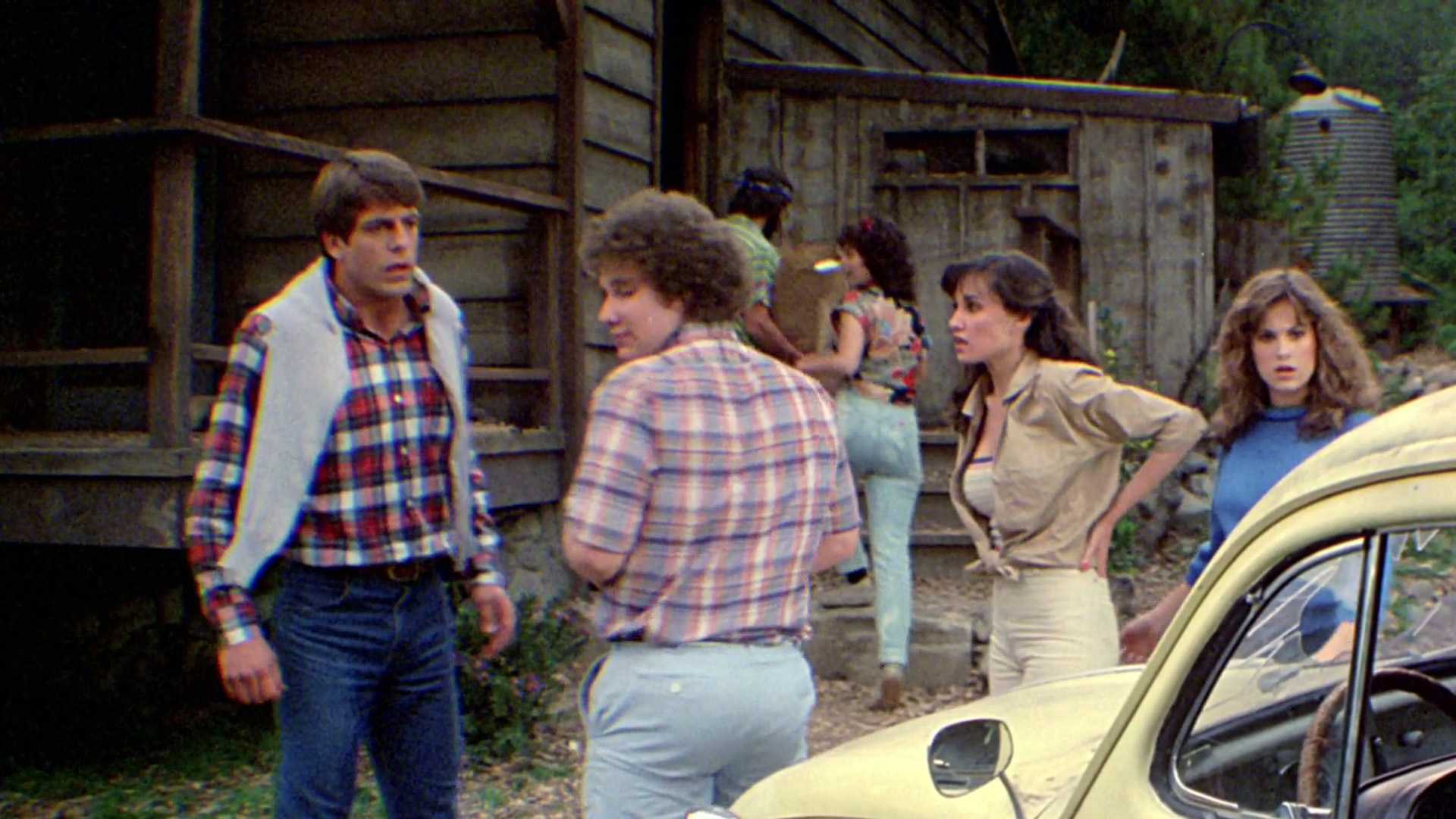
Early on in the development of Part III, Miner had flirted with the idea of continuing the story of Part 2 survivor Ginny Fields (Amy Steel) as she recovered from her ordeal in a mental hospital but Miner and his collaborators decided not to break from the successful Friday formula. So rather than a tale of a survivor coping with their trauma inside the walls of an institution, we get a classic Friday set-up. Final Girl Chris Higgins (Dana Kimmel) goes out to her family's place on Crystal Lake to spend the weekend with her boyfriend Rick and a group of friends, only to have Jason waiting there, ready to pick them off one by one. Had Part III decided to mix things up, even a little, the series might have headed in a more unconventional direction but instead Part III established Friday's pragmatic, if it ain't broke don't fix it approach. 

Even when later entries would introduce a left field element like a telekinetic teen or when they transported the action to an unlikely locale like Manhattan or, um, space, those installments were still rooted in the same body count narrative. Part III could have changed the course of the franchise but instead it insisted that it stay the course. Ultimately this was the smart and correct move.

Credit for the introduction of the iconic hockey mask has being claimed by/assigned to different parties but however Brooker's Jason came to be wearing that familiar face gear, it doesn't really matter. It's not as though it got there through any burst of creative inspiration. It was, ironically given the series' namesake holiday, simply a matter of luck. The idea that audiences would respond to the mask so strongly was impossible for anyone to predict. Movie by movie, Friday the 13th had fallen ass-backwards into its mythology and Part III was where everything finally came together. It was also the moment where Friday the 13th as a series really stepped on the gas just as the Halloween franchise took the foot off theirs. 


Up until Part III, Friday the 13th had been the second place slasher franchise behind Halloween. But in '82, just as Jason found his groove with his snappy makeover, Halloween ditched Michael Myers in favor of Silver Shamrock masks. As much as Season of the Witch has gone on to become a cult favorite, it put Halloween in a hole just months after Part III had been a big summer hit. Serving the fans the slickest slasher spectacle of the early '80s allowed Friday the 13th to surge at the right time. After that, Halloween found itself in the position of playing catch up with Friday the 13th. Jason might not be one for making 5D chess moves but in '82, his 3D moves were enough to make him look like one savvy slasher. 

Sunday, August 7, 2022

All The Damn Vampires: The Lost Boys at 35

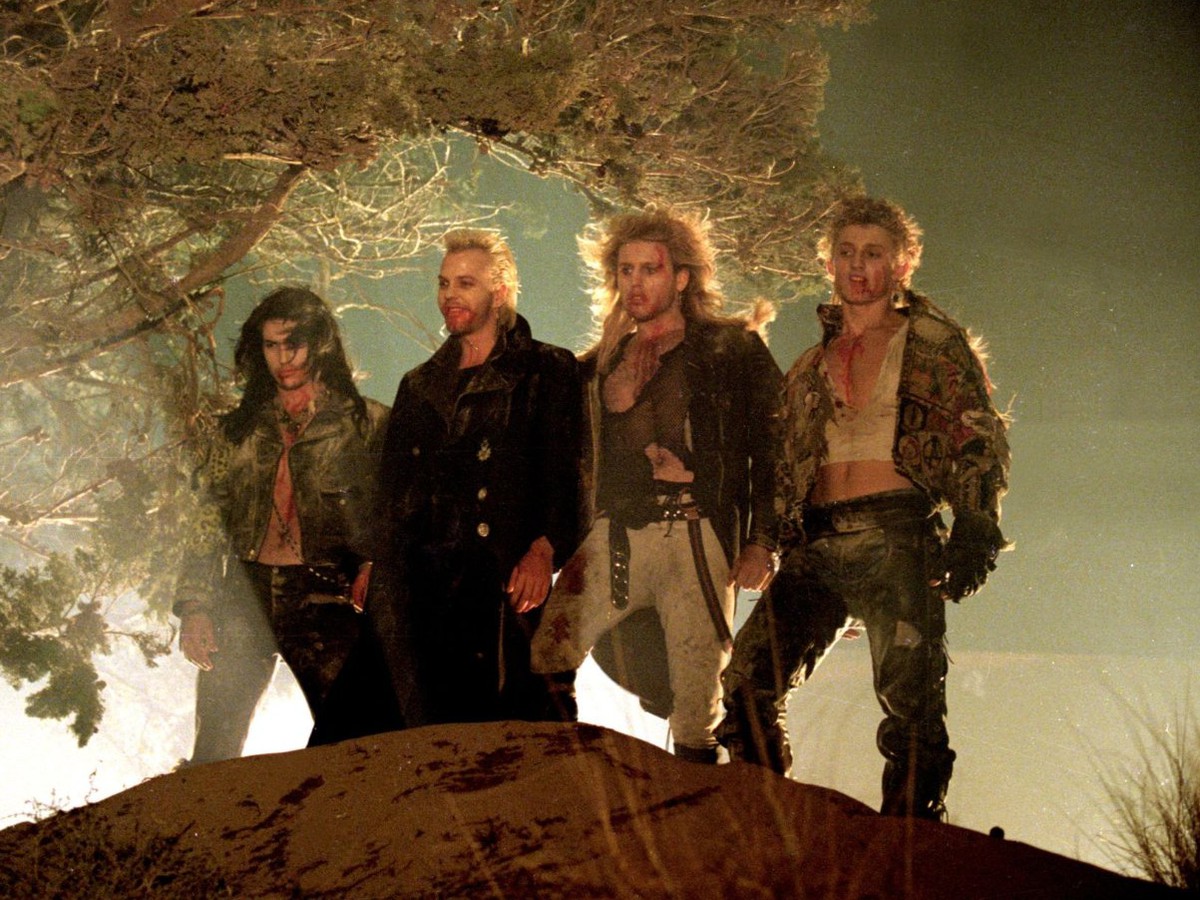
Back in the summer of '87, no one would have thought to consider The Lost Boys as a classic. Not that director Joel Schumacher's hip take on vampires wasn't well received, only that its veneer of glossy superficiality made it hard to believe it would leave any lasting (bite) mark on the genre. Produced by Richard Donner and Harvey Bernhard, collaborating again after Bernhard had produced the Donner-directed hits The Omen (1976) and The Goonies (1985), The Lost Boys had an impeccable commercial pedigree and it glowed with a mainstream shimmer in the hands of Schumacher and cinematographer Michael Chapman (Taxi Driver, Raging Bull). While it was not the first vampire movie to adopt the visual language of the MTV era - director Tony Scott's 1981 stylish cult fave The Hunger had gotten there first - The Lost Boys was the first to embrace MTV's attitude and, more importantly, its audience. This was pop horror aimed squarely at the MTV generation. 

Prior to The Lost Boys, vampire movies made life as a bloodsucker out to be a curse. The only cinematic vampire who seemed to be having any fun at all was George Hamilton's campy Count of Love at First Bite (1979). The major innovation of The Lost Boys was that it was the first non-spoof to portray the vampire lifestyle as being a blast. Its vampires weren't lonely, brooding figures, they were a gang of buddies who wore the coolest clothes and partied every night. Before The Lost Boys, vampires had been solitary creatures. Even when there was more than one vampire around, as in Brides of Dracula (1960), they weren't chummy with each other and they didn't possess any individual autonomy. They were just subservient to whoever turned them and they fed off the scraps their master left behind. But the vampires of The Lost Boys weren't stuck sulking in a castle begging for leftovers. They were out having a good time.  

Director Kathryn Bigelow's Near Dark, released later that year, also featured a pack of vampires but the vagabond crew of Near Dark, while tight-knit, led a much more hard scrabble, skin of their fangs existence than that of the Lost Boys. The words "Sleep all day. Party all night. Never grow old. Never die. It's fun to be a vampire." would not have fit quite as well on the poster for Near Dark as they did on that of The Lost Boys. Not that the nocturnal family of Near Dark didn't have their own brand of fun but, for the most part, they did not have the same glamour or youthful sexiness of The Lost Boys. Right when we first meet the vampires of Near Dark, they're already looking past their expiration dates. The nights have been hard on those guys. On Kiefer Suthlerand's David and his boys, not at all. They're thriving.

The fact that David and his crew are all destroyed at the end of Lost Boys does not feel like a strong condemnation of the choices that put them there. No one ever walked away from watching The Lost Boys thinking that these guys weren't living the life. Sure, Star (Jami Gertz) and Laddie (Chance Michael Corbitt) and Michael (Jason Patric) wanted to opt out of the whole deal but I think the takeaway from that is that being a vampire isn't for everybody. Some people aren't up for it. But if you can hack it, The Lost Boys seems to say, you should absolutely go for it. For their part, David and the boys do not appear to miss their humanity whatsoever. They're having a ball, all the way till the end. They might get killed but they are unrepentant. They like being vampires and Schumacher and screenwriter Jeffrey Boam don't try to convince us that they shouldn't.  

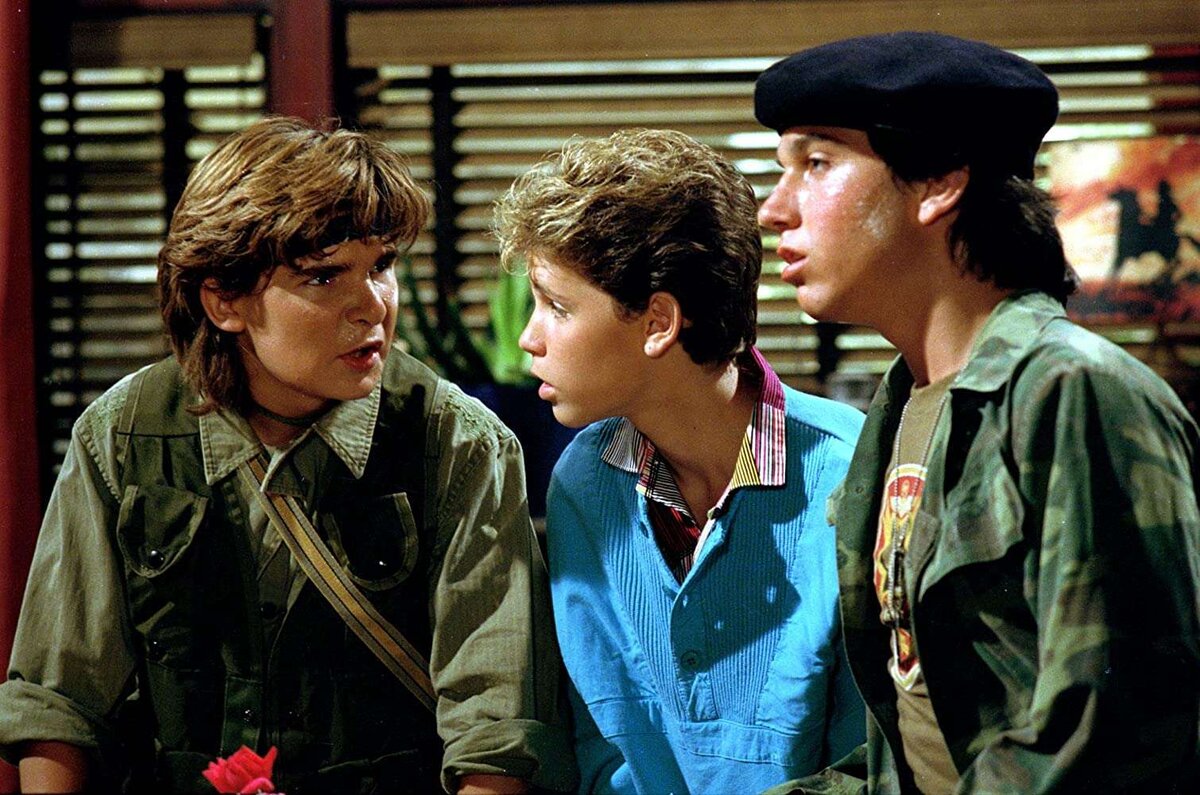
At the same time, Schumacher's charismatic young cast - particularly Corey Haim as Sam and Corey Feldman and Jamison Newlander as self-styled fearless vampire killers Edgar and Alan Frog - are able to keep their anti-vampire squad personable and funny rather than appearing to be kill joys. The forces traditionally aligned against Dracula - Van Helsing, Jonathan Harker, Dr. Seward and the rest of the righteous men intent on killing the Count - have always felt like the forces of repressed male Victorian society protecting their world against an element of raw passion and sexuality that will, unless stopped, seduce (and liberate) their women. The Frog Brothers are uptight in their own way but their hard line against the bloodsuckers seems motivated by civic duty rather than by any puritanical impulses. They're not against pleasure, as we suspect Van Helsing and his crew are, they just see vampires as an infestation that needs to be purged. 

Keep in mind that the Frog Brothers are part of the business community of Santa Clara (you might say they have a stake in its success...ok, maybe you wouldn't). They watch over their parent's comic book store so the idea of vampires prowling the boardwalk and feeding off prospective customers is something they would naturally be against. These punk vampires are reckless, they walk around like they own the place and the bottom line is that they need to be dealt with. The Frog Brothers believe in the virtues of capitalism and law and order (if they were old enough to vote, you know they'd have been all in on Reagan and the '80s GOP). They are part of that '80s breed of young conservatives that rejected the free spirit, hippie ethos of their parents (we see their parents passed out in the comic book store, still dressed like it's 1968). If they have to go Rambo on some vampires to keep the boardwalk safe, so be it. 


While David is the star vampire of The Lost Boys and the one that obviously gets all the attention, I find head vampire Max (Edward Hermann) to be a more interesting figure to try and wrap my head around. We only find out that Max is a vampire in the film's final scenes and he is staked almost immediately afterwards but I have so many questions about this guy. For starters, I have to imagine that, even in vampire circles, there's some kind of unspoken code of conduct and I gotta believe that trying to get to a woman through her children is considered to be crossing a line. Even for a bloodsucking ghoul, it's such a cheap move. Unlike most vampires, who are driven by their sensuality and by centuries' old romantic longings, Max doesn't seem to have any burning lust for Lucy (Dianne Wiest), he's more interested in finding a suitable mother figure to get his pack of unruly vampires in line. He claims he still wants Lucy even after the deal with David goes south but I don't buy it. Max is for sure never going to tell Lucy that he crossed oceans of time to be with her. He's just hoping she's in the mood to settle. 

When Max looks at what David and the rest of the boys are up to every night, does he really think being a counter jockey renting out videos is the best use of his undead existence? If he was operating a cool little indie movie house, sure. There's a romance to that. You can definitely see how a vampire would fall in love with screening cult films for the midnight crowd. Collecting late fees on overdue copies of Short Circuit, though, not so much. This guy could do far better with what he has to work with is what I'm saying. 

During their first meeting, after Max has ordered David and the boys out of his store, Lucy says to Max "Oh, they're just young. We were that age too, once." But in Max's case, I'm not so sure. If this guy was ever young, he must not have had dreams. 

As Sam says, to Hell with Max.


The final lines of many classic horror films serve as a warning ("Keep watching the skies!") that caution the audience to not let their guard down but The Lost Boys' last lines are about restoring a sense of calm. Barnard Hughes' Grandpa walks to the fridge after sending a giant log torpedoing through Max's chest and deadpans: "That's the thing I never could stomach about living in Santa Clara. All the damn vampires." First and foremost it works as a killer punchline before the final fade out but it also, without trivializing, smooths over the tumultuous events of the film. Most horror movies look to leave you feeling uneasy and unsettled but not The Lost Boys. The worry free note that it leaves off on secures The Lost Boys' place as pure horror movie comfort food. 

For a movie that initially seemed to be chasing the trends of the time, the biggest tribute to The Lost Boys is that it continues to be an ongoing influence that has redefined the depiction of vampires in popular culture. What in 1987 seemed like nothing more than lightweight summer fare proved to be a game changer. Not every great horror movie is about breaking taboos or being transgressive. Sometimes great horror movies are simply about providing fun and escapism and The Lost Boys is the quintessential example of that. 

35 years later, its legions of fans still believe. 

Thursday, July 28, 2022

Jordan Peele's Wild Kingdom


Prior to its release, writer/director Jordan Peele's third film Nope looked like it was going to be a new entry in the alien invasion subgenre. Now that it's out, that continues to be how people are categorizing it but I think it actually should be considered as a stealth entry in the Man vs. Nature subgenre. The sky-dwelling creature that stalks the characters in Nope may not have fur or teeth or claws but it definitely is an animal. The common belief is that it's of extraterrestrial origin but I say that is not confirmed, only assumed. It may be extraterrestrial but it could just as well be extra dimensional or any number of unknown options. In the end, we don't know. In Nope, the characters make several false assumptions about what they're dealing with so for audiences to also automatically jump to the conclusion that it is an alien may also be a mistake. Whatever the creature is, it is a natural predator and how the characters of Nope react to it, for good and bad, hinges on their prior experience with animals. 


Nope is refreshingly clear of cliches in the way that only a diehard genre fan could conceive of. Peele knows the conventions of horror and sci-fi inside and out. He knows what's been done before, what expectations other genre fans will bring to a film, and he does an expert job of defying those expectations. Setting Nope up to be a traditional alien movie is a brilliant fake out. Peele invokes the classic image of the tin plate flying saucer that genre fans would recognize from classic '50s sci-fi films like Earth vs. The Flying Saucers (1956) but proceeds to do something entirely different with it. Even if you choose to take this at face value as a straight up alien film (which it may well be), Peele is still twisting expectations and not taking what genre fans would recognize as a familiar route. Watching Nope, I couldn't help but marvel at Peele's cleverness. I'm writing this review with the assumption that anyone reading it will have seen Nope so major spoilers the rest of the way out.

While Peele leads the audience (and his characters) to assume that the presence that hovers over the Haywood Hollywood Horses Ranch is a flying saucer that periodically descends from the clouds to bring animals, people, and various random objects aboard, it is eventually revealed to be a living creature that has become territorial and unwelcoming to intruders. Rather than the familiar trope of aliens scooping up specimens to experiment on, the creature of Nope is actually ingesting what it takes into itself. To our surprise, it isn't abducting anyone, it's feeding.

There are no scientists or experts in Nope to give their theories on what the creature is or where it comes from. As with the Graboids of Tremors, there is no origin provided. Is it a part of the natural world that hasn't been discovered until now? Is it an extraterrestrial? Is it some kind of mutated life form? Who knows? What it is and where it comes from is irrelevant to Nope's characters. Siblings Otis Haywood Jr. (Daniel Kaluuya) and Emerald Haywood (Keke Palmer) are initially operating under the belief that they're dealing with alien visitors and that this is just a straight up UFO. So too is former child actor Ricky "Jupe" Park (Steven Yeun) who runs the Western themed park Jupiter's Claim located close to the Haywood Ranch. All these characters have their own ideas on how to cash in on this new visitor. 

Otis ("OJ") and Emerald ("Em") see the chance to conclusively document a real UFO as a means to save themselves from the financial ruin that their family business has been facing since the sudden death of their father, Otis Haywood Sr. (Keith David), six months earlier. For his part, Ricky wants to parlay the UFO into a hit attraction (the "Star Lasso Experience") for his theme park but none of them understand what they are even dealing with.

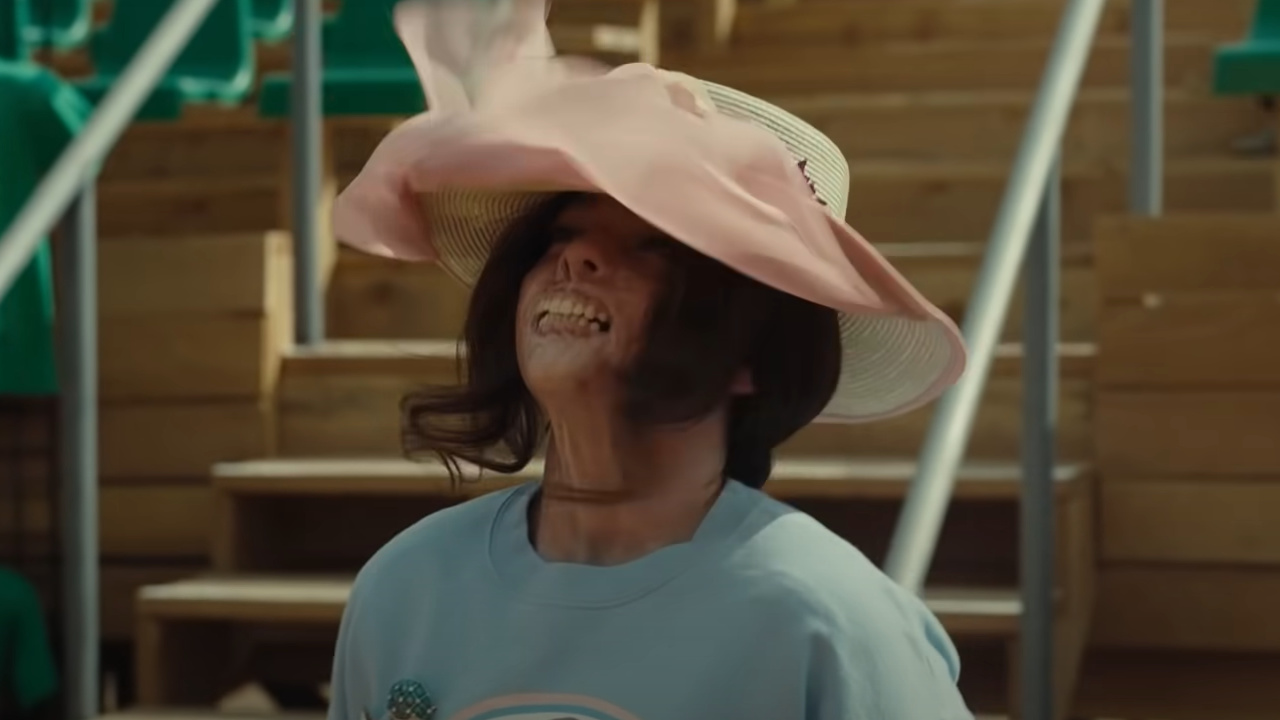
As someone who has spent their life as a horse trainer, once it is eventually determined that the object isn't a ship but a living being, OJ comes to recognize that it has to handled as one would a wild animal, with caution and respect. Ricky's fatal mistake is that he imagines that he has a personal connection with whatever it is. Ricky's back story is that he was a child actor on the set of a '90s sitcom called Gordy's Home, with the titular Gordy being an adorable chimp, until one day helium balloons being used in a scene floated up into the hot studio lights and exploded, which provoked a frightened Gordy into a violent rage. The other actors, including the young girl playing Ricky's sibling, were badly mauled while Ricky himself escaped unscathed. As Gordy was reaching under the table where Ricky was cowering to give him the fist bump that they performed in the show, a police bullet through his brain took out Gordy. 

We see this harrowing event play out in flashback from Ricky's terrified perspective as a child while the adult Ricky recounts the event to OJ and Em by describing the SNL sketch that lampooned it, with Ricky glowing with praise for Chris Kattan's portrayal of Gordy. Putting aside the question of whether SNL would actually perform a sketch based on an event involving the maiming of real people (one of whom was a minor), what is compelling about this scene is how Ricky chooses to view the great trauma of his life through a buffer of entertainment. This was a life-altering moment in which he watched his co-workers be brutally attacked and he saw an animal's brains blown out in front of him but rather than cope with the pure horror of that event, he references it not by way of his own first hand experience but through a second hand, satirical depiction.

This says that Ricky has never truly processed what happened to him. Talking about the event from his own perspective would require introspection. It would require sharing something that is unpleasant, uncomfortable and most of all, real. By referencing it by way of a comedy sketch, he is reducing it to a pop culture "moment" rather than an experience that emotionally scarred him. 

Ricky dubs the imagined occupants of what he believes to be a ship The Viewers, furthering the idea that Ricky sees everything as entertainment to be safely packaged and consumed. For his Star Lasso Experience presentation he has his kids dressed in alien costumes, he's got a stand of alien themed merchandise to sell, he's wearing a specially designed sequined jacket with a UFO on the back and he has a prepared speech to deliver to the crowd about the life changing experience they're all about to witness but all that's going to happen to any of them is that they're going to become this creature's lunch. The Star Lasso Experience ends with every attendant screaming their way to an agonizing death as they move through a creature's digestional tract. There's not even the relative dignity of being probed on an alien exam table. There's just the very unglamorous reality of being an animal's meal.  


Animals aren't trying to hustle anybody. They hunt, they feed, they protect their territory, they react unpredictably when they feel threatened (like the horse that OJ loses control of during a shoot thanks to a careless crew member). They do not enter into business agreements and they do not look to pose for any cameras. Las Vegas entertainers Siegfried and Roy are referenced at one point in Nope, the most famous instance of people who thought they had a deal with the animals they were working with only to discover to their horror how one-sided that arrangement was. 

The difference between man and animal as illustrated by Peele carries all the way through the film's final chase as the creature zeroes in on OJ and Em. Typically the final chase in a horror movie is purely about survival. Whether it's about staying one step ahead of Jason or Michael Myers or a zombie horde, the remaining characters at that point are always reduced to their own animal states, desperately focusing on staying alive. That is not the case with Nope, however. As desperately as OJ and Em are working to stay ahead of the creature in the final stretch, Em does not let go of her need to get that shot. We've seen countless final chases where it's all about the characters just wanting to get away with their lives and that's it. But this is a big final chase in a horror movie where it's not just about surviving the moment, it's about surviving. Em, who through most of the movie seemed to be the more flaky, less business focused of the two siblings, shows in the end how much she has her eyes on the prize. She knows that it won't enough for her and OJ to just evade this creature and live another day. This about living past that. If they don't get that shot of the creature, if they don't score that winning ticket that will get them out of their economic situation, they've got nothing. The idea of having its characters be in financial as well as physical peril is such a novel wrinkle for a horror film. The creature is only protecting what it sees as its territory. It's pursuit of OJ and Em isn't even personal. It's instinctual. But Em has to think beyond the moment in a way that the beast that's stalking her doesn't. 

In the man vs. nature subgenre, whether you're talking about Jaws (1975) or Grizzly (1976) or Razorback (1984), the final battle always comes down to the final survivor having to destroy their attacker. The goal is just to fucking end it. Preferably in spectacular fashion. But OJ and Em's motivation is never to kill the creature. Even though it is technically a threat, they're never worried about it, say, making its way to a populated area. They're not actively looking to stop it. Their entire conflict with it is purely driven by their hopes of scoring a life changing pay day rather than, say, righteous revenge. I think that is an aspect of Nope that is hard to audiences to wrap their heads around. It's just not how the conventions of the genre traditionally play out. Audiences are primed to expect that big payoff where they and the characters revel in the death of the creature. Brody making the shot that explodes the scuba tank in the shark's mouth, Val tricking the last Graboid into burrowing its way out of a cliff side at full speed, sending it plummeting to a splattery death. That is not what Nope is about. It's creature is never demonized in any way. It's never portrayed as purposely malevolent. The deaths it causes are either incidental or caused by people unthinkingly provoking it. To have the big climatic win in Nope be about Em successfully getting that picture rather than OJ and Em high fiving over the creature's shredded carcass is just not the kind of vindication that audiences are conditioned to expect and I think that has led to a sense of dissatisfaction. The fact that Nope doesn't play by the rules is to Peele's credit but it is also why it has not been an across the board crowd pleaser.   

Personally, I will say that my experience in watching Nope was one of being objectively impressed with the scope of its ambition and with the technical skill of the filmmaking rather than feeling viscerally drawn in. But as an example of craft, Nope continues to show Peele's considerable development. It offers images that are entirely unique to it along with an assemblage of excellent performances (shout out to the dryly funny Michael Wincott as a jaded, seen it all cinematographer). I don't believe Nope works as well as Get Out or Us but it's still a movie that deserves to be applauded, even as many fans and critics seem more than eager to slam it for not being exactly what they were expecting. 

Whether Nope is Peele's best film to date, his first misfire, or somewhere in the middle is ultimately irrelevant. The bottom line is that it's another original work by a writer/director who truly understands and loves the genre and whose work continually provokes discussion. That's something that every horror fan should be saying yes to. 

Sunday, July 24, 2022

Give Peace a Chance: Superman IV at 35

At yesterday's San Diego Comic Con, the big disappointment for many was that internet rumors of Henry Cavill making a surprise appearance to announce his return to Superman turned out to be a bust. No Cavill, no new Superman. That leaves the character's last big screen turn as being 2017's Whedon cut of Justice League. When superheroes are the hottest thing in popular entertainment and the character that every one of them is derived from is sitting idle, that seems like a major fuck up on somebody's part. Superman should be the crown jewel of Warner/DC's catalog but the best they can do for him these days is a low rent CW show. Tyler Hoechlin does a decent job as Clark/Superman but come on, this is Superman. This is a character who should have a blockbuster movie in theaters on a regular basis but instead his last solo film was almost ten years ago and he's slumming it on the CW. Doesn't seem right. 

Where it did all go so wrong for Big Blue? 1978's Superman: The Movie made the case that comic book heroes belonged on the big screen in the first place and 1980's Superman II was widely considered to be an improvement on the original (debatable, I say, but a case can be made). Superman's cape started to fray with the more comedic Superman III (1983) but it was 1987's Superman IV: The Quest for Peace that backed a dump truck of Green K over the Man of Steel. It wouldn't be fair to blame Peace for why 2006's Superman Returns or 2013's Man of Steel failed to recapture Superman's former box office glory. The people behind those films made their own mistakes but Superman IV is undeniably where the Metropolis Marvel's flight plan started to go off course and it's never gotten right since. 

Released on July 24th, 1987, it was immediately clear that Peace would not represent a return to form for the franchise. The first three Superman films - the first two, in particular - had set the standard for special effect extravaganzas. They were top of the line Hollywood productions. As a Cannon Films production, however, Peace was not. As soon as the titles came up, it was obvious that this was going to be a much schlockier affair than audiences were used to seeing from Superman. III had its faults but there was no mistaking that it looked good. It was a summer spectacular that was still worthy of the brand. The only thing Peace had going for it was John Williams' signature Superman theme (adapted and conducted by Alexander Courage) and Christopher Reeve, the man who had defined Superman for a generation.

The sincerity that Reeve had always brought to the role served Peace's topical storyline well. Moved by a letter from a young fan who wondered why Superman didn't take it upon himself to do something to prevent Earth's superpowers from annihilating the planet in a nuclear conflict, Superman rounds up all the nuclear weapons and hurls them into the sun. Of course that doesn't sit well with everyone. Specifically it doesn't sit well with black-market arms dealers who want to restock the world with nuclear weapons. With Superman's arch foe Lex Luthor (Gene Hackman) having just been busted out of prison by his nephew Lenny (Jon Cryer) and, as usual, looking to play an angle that will make him rich and Superman dead, Luthor gets in bed with these arms dealers and with a stolen strand of Superman's hair attached to a nuclear missile that Superman intercepts and throws into the sun, Luthor (through very vaguely described means) causes the birth of the solar powered and glittery costumed menace known as Nuclear Man. 


Storywise, there's absolutely nothing wrong with Peace. The plot hinges on Superman making a moral decision that has worldwide repercussions. As Superman should, he acts on his conscience, with only good intentions, and the complications of the story arise from a cynical world pushing back against his idealism. In the end, Superman is forced to concede that he can't make unilateral choices on behalf of the world, even as he implores the leaders of the world and its people to make it their mission to choose peace. Along the way, there's big action, enjoyable mischief from Luther, romantic complications for Clark and Superman, drama at the Daily Planet as the paper is bought out and turned into a tabloid, and the usual comedic antics related to Clark juggling his dual identities. This is all classic Superman stuff. 
 

Superman IV's failures all lie in the execution and those faults all come down to the fact that the money wasn't there. When you're doing sequels, you have to continually raise the bar and the makers of Superman IV were forced to do it all on the cheap. The final product couldn't help but send the message that Superman wasn't a character that mattered anymore, that he was no longer worth the top shelf treatment that he used to get. 

I believe if Peace had shared the same level of production values as the first three films, it would have been seen as a comeback for the series because even with the shoddy special effects, a lot of cool shit happens. The battles between Superman and Nuclear Man are, in concept, the same kind of epic action seen in Superman II when Superman fought the Phantom Zone criminals in the middle of Metropolis. In Peace you've got action set in an exploding volcano, at the Great Wall of China, and in the heart of Metropolis as Nuclear Man rips the Statue of Liberty off her foundations (I guess we just go with the idea that in Superman's world, there is no New York City and the Statue of Liberty calls Metropolis home) and hurls it as a projectile. Superman even fights Nuclear Man on the moon. This is all prime Superman spectacle that feels torn from the panels of a comic. The fact that the money wasn't there to give these scenes their proper due doesn't mean that they aren't worth appreciating. Especially given that no Superman movie since has shown any interest in having this much fun. 

It's a crime that with all the money and technology at his disposal, all director Bryan Singer wanted to have Superman do in Superman Returns is lift stuff. And also have him spend Returns' last half hour or so in a coma. To have Superman spend pretty much the entire last act of a movie - and not just any movie, mind you, but what is supposed to be the character's big comeback after almost twenty years - in a hospital bed, that's a problem. Kind of makes you think that no one involved knew what the hell to do with Superman. On the upside, at least Zack Snyder believed in bringing big scale spectacle back to Superman when he did Man of Steel. Unfortunately that translated to letting Superman turn Metropolis to a pile of rubble in a reckless battle with General Zod and then having him murder Zod by snapping his neck. Definitely sent the message that good times were back. 

Come on, bring the kids! 

Superman IV may have not had two pennies to rub together but at least the creative people involved understood what the proper spirit of a Superman movie should be. When Nuclear Man is torching Metropolis to get to the object of his obsession, Lacy Warfield (Mariel Hemingway), the daughter of the Planet's new media mogul owner, Superman acts immediately to get Nuclear Man off the streets and spare Metropolis any further destruction. What a novel concept! 

This is also a movie where Superman is fully allowed to be his sincere self, steadfast in his convictions to the point of appearing corny. When he lands on the moon in the process of dealing with Nuclear Man, he pauses to make sure the American Flag is straightened. When it is knocked over during his battle with Nuclear Man, he doesn't leave without setting it right again. After he rounds up Luther and Lenny, before taking Luthor back to jail he delivers Lenny to a Boy's Home telling the clergyman at the gate that, hey, this was just a kid under a bad influence. And when Luthor asks Superman whether the world is going to be vaporized now that the world's superpowers are getting their nuclear arsenals back, he says that, no, the world is always where it was, "on the brink, with good fighting evil." Whatever stumbles Peace made, it absolutely got Superman himself right.

It's hard to imagine any subsequent Supermen delivering the line Reeve says outside of the United Nations as he surrenders the idea of taking the nuclear option off the table but urges the people of Earth to see better days for themselves, telling the world "...What a brilliant future we could have." 


Sadly, Superman did not go on to a brilliant future post-Peace. Outside of the tragedy that awaited Reeve in real life, this iconic character that served as an inspiration for generations became stuck in the hands of people who didn't have the first clue of what to do with him. Ideal candidates like Brandon Routh and Henry Cavill have been cast but their potential for greatness in the role has been let down by everyone else charged with guiding Superman back to the screen. 

No one even knows how to get the costume right anymore. I would say that, yeah, I get that it can't be the same as what Reeve wore but, you know, that kind of was the costume. If you're doing Superman, you can't really improve on it and the subsequent variations have only proven that. Update all you want but two things have to be spot on: the look of the 'S' chest emblem and the colors should be correct, starting with actually having colors. Bizarro recently appeared on Superman & Lois as the "dark" Superman and it's not an exaggeration to say that you could hardly tell who was who. It's enough to make you want to ask the people handling the live action Superman these days, "Why are you purposely fucking this up?" 

At this point, it's hard to imagine the classic version of the character (or frankly, even a shitty version) ever making its way back to the big screen. So as much as Superman IV was a crushing disappointment back in '87, the fact that it will surely remain the last theatrical appearance of a truly iconic Superman has turned it into something worth treasuring. It's the Man of Tomorrow, as lit by yesterday's glow.