Monday, September 26, 2022

One Man Can Make a Difference: Knight Rider at 40


Today's pop culture landscape is saturated with superheroes in film and TV but that was not the case in the early '80s. Larger than life heroes were relatively few and far between back then. You had plenty of action heroes, sure, but as far as heroes that met the "super" criteria, not so much. Whether Michael Knight fell into that category may be debatable to some but I say he qualifies. Sure, he was not a superpowered mutant, he wasn't bit by a radioactive spider, and he didn't even have a colorful costume. What he did have, however, was a car. The Knight Industries Two Thousand, to be specific. Beginning on September 26th, 1982, to the beat of one of the greatest synth themes of the '80s, Michael Knight rode into adventure behind the wheel of K.I.T.T., the talking automobile that was a four wheeled scourge of crime.  

Michael and K.I.T.T. (voiced to dry perfection by St. Elsewhere actor William Daniels) worked under the direction of F.L.A.G., the Foundation for Law and Government (Knight Rider was a show that loved its anacronyms!). Even though Michael was just a regular guy, being partnered with K.I.T.T. gave him an edge in the fight against criminals who operate above the law. Just as the Lone Ranger always counted on his trusty steed Silver to carry him in a flash to wherever his help was needed, Michael relied on K.I.T.T.'s unmatchable horsepower to make him the fastest force for good on the streets. Described in the show's opening narration as "a young loner on a crusade to champion the cause of the innocent, the helpless, the powerless," Michael Knight was as devoted to helping the underdogs of the world as any masked avenger. 


He didn't have any powers to call his own but Michael putting K.I.T.T.'s abilities into action each episode, most often by activating the Turbo Boost function that would send K.I.T.T. flying over any obstacle, gave Knight Rider its superhero flair. Some might argue punching a button doesn't qualify as a real skill, much less a super one, but hey, not everyone would know when to hit it. It's not just about hitting a button, man, it's about the timing. For all the technology he's pimped out with, K.I.T.T. is only as good as the guy driving him.


Like any good superhero, Michael had an origin story (an L.A. cop named Michael Long who was left for dead after being betrayed and shot, he was "reborn" under the care of Knight Industries and given a new face and new identity) and a motto that drove him in his pursuit of justice ("One man can make a difference," the words of his late benefactor Wilton Knight). He also had a Nick Fury-type boss in the form of F.L.A.G. leader Devon Miles (Edward Mulhare) to give him assignments (no, Devon wasn't a Fury style bad ass but he was the guy giving the orders). He also had his own Q type figures with tech wizards Dr. Bonnie Barstow (Patricia McPherson) and April Curtis (Rebecca Holden) who he relied on to keep K.I.T.T. running.
 

Michael even had an evil double, Garthe Knight, that served as his nemesis as did K.I.T.T. (the wicked K.A.R.R. - Knight Automated Roving Robot). The fact that Michael and K.I.T.T. had legit arch enemies to face off against is more than comic book legends Spider-Man or The Incredible Hulk could lay claim to in their own live action TV adventures of that era so I say Knight Rider is more than fit to be mentioned in their company. If Tony Stark is a superhero because he wears a high tech suit of armor, then Michael Knight is a superhero with a suit of armor that he just happens to drive. 


Michael was guided by the belief that one man can make a difference but sometimes one show can make a difference. I might not be able to pinpoint the exact difference Knight Rider made, no, but I do know for a fact that the '80s would not have been the same without Michael Knight and K.I.T.T.. 


While David Hasselhoff's acting prowess is seldom, if ever, acknowledged, I say with no irony or snark that he deserves considerable credit for selling the relationship between Michael and K.I.T.T.. There are a lot of world class actors who couldn't have made a friendship between a man and his talking car work the way that Hasselhoff did so I think it's unfair for people to dismiss it as unchallenging work. Not everyone could do it, is all I'm saying. You never doubted that these two were best buds, travelling together down the actual and metaphorical road of life. Forty years later, that "shadowy flight into the dangerous world of a man who does not exist" remains a ride worth taking. 

Tuesday, September 20, 2022

Djinn, No Chaser: Wishmaster at 25

The search for the next horror superstar continued in earnest throughout the '90s. The old guard of Freddy, Michael and Jason saw their fortunes flagging during that decade but the promise of finding another character that could deliver the same kind of impact and spearhead a successful franchise led studios to keep trying, undeterred by failure. Audiences, though, for the most part kept refusing to grant the wish of filmmakers who hoped they had the next Freddy on their hands. 

When Wishmaster arrived on September 19th, 1997, the horror genre was in the most robust state it'd been in some time. In '96, Scream had given the genre its biggest, buzziest hit in ages and studios were looking to cash in on the renewed appetite for horror. For the most part that meant a new wave of teen slashers, with movies like I Know What You Did Last Summer, that were directly chasing after Scream's audience with hot young casts and hip attitude. Wishmaster, however, was an FX-heavy '80s throwback designed to appeal to the dyed-in-the-wool horror base. There was nothing hip or post-modern about Wishmaster. Embracing sincerity rather than irony, it was a movie for horror nerds, by horror nerds. 

Every department of Wishmaster was occupied by seasoned genre vets. The script was by Hellraiser sequel scribe Peter Atkins. Robert Kurtzman (the "K" in hot FX house KNB) was directing. It was produced by Pierre David, who had previously produced Cronenberg classics like Scanners and The Brood. Wes Craven, with his name having renewed box office cachet since Scream, was on board as executive producer and Friday the 13th composer Harry Manfredini provided the music. If you were a horror fan in '97, it was easy to feel confident that Wishmaster was going to be speaking your language. This wasn't going to be some cynical, trend chasing horror effort. It was made by the kind of people who, like you, were always into the genre through thick and thin. 

When you have the Tall Man himself, Angus Scrimm, delivering the first words spoken in your film (via voiceover narration for an opening text that explains the Djinn), you're playing to a very specific audience. Then you add in cameos by Kane Hodder, Robert Englund, Tony Todd, Ted Raimi, Joe Pilato and Reggie Bannister and you're looking at the guest roster for a Fangoria Weekend of Horrors convention. Wishmaster was pitched to a certain crowd but, to its credit, it didn't take that audience's interest for granted. Wishmaster is more than just fan friendly shout outs. 

Atkins' script is not the kind of screenplay that wins mainstream accolades but it knows how to meet the demands of the genre and it does so smartly. Kurtzman's direction is workmanlike but capable and he gets the most out of Wishmaster's big set-pieces. The FX by KNB are of their usual high quality and it is, to no surprise, a strong showcase for them with the Djinn getting to cause all kinds of chaos. It's the kind of FX extravaganza that would have fit in perfectly in the '80s with a lot of prosthetic work, minimal CGI, and somehow it miraculously earned a R from the MPAA. For horror fans in the late '90s, Wishmaster provided the kind of ride that was rare in that era. 

As the titular menace, Andrew Divoff (Graveyard Shift, Air Force One) really goes for it. He is not striving for a vibe of understated menace here. No, he's taking big swings with every line. But when those lines are of likes of "Run, insect! Run and tell those you will, what you will Tell them there is something loose in their city that feeds on wishes!" that is the only correct choice. In a film where he's sharing the screen with Freddy, Jason and the Candyman, Divoff makes a convincing case that the Djinn belongs in their company. Giving him a leg up, KNB provides Divoff with a memorable look for him in his Djinn form. Facing off against him is Tammy Lauren as Regal Auctioneers appraiser Alexandra "Alex" Amberson. Mostly known as a TV actress then, Lauren makes for a smart, resourceful heroine. It's somewhat surprising, actually, that she didn't have more genre roles after this. She gives Alex the kind of resiliency that's comparable to classic horror heroines like Laurie Strode and Ellen Ripley. 


Wishmaster was not one of the bigger genre hits of its day but it did well enough to spawn a run of direct-to-video sequels (with Divoff only returning for one more entry). When Wishmaster was released, the Djinn instantly became a member of that '90s horror franchise crew that included the Leprechaun and Warlock. None of them ever became the household names that Freddy or Jason were but yet they still racked up a few movies and earned followings of their own. Fans might have wanted to wish for more for the Djinn but, as Wishmaster taught us, sometimes it's better to be satisfied with what you've got. 

Sunday, September 18, 2022

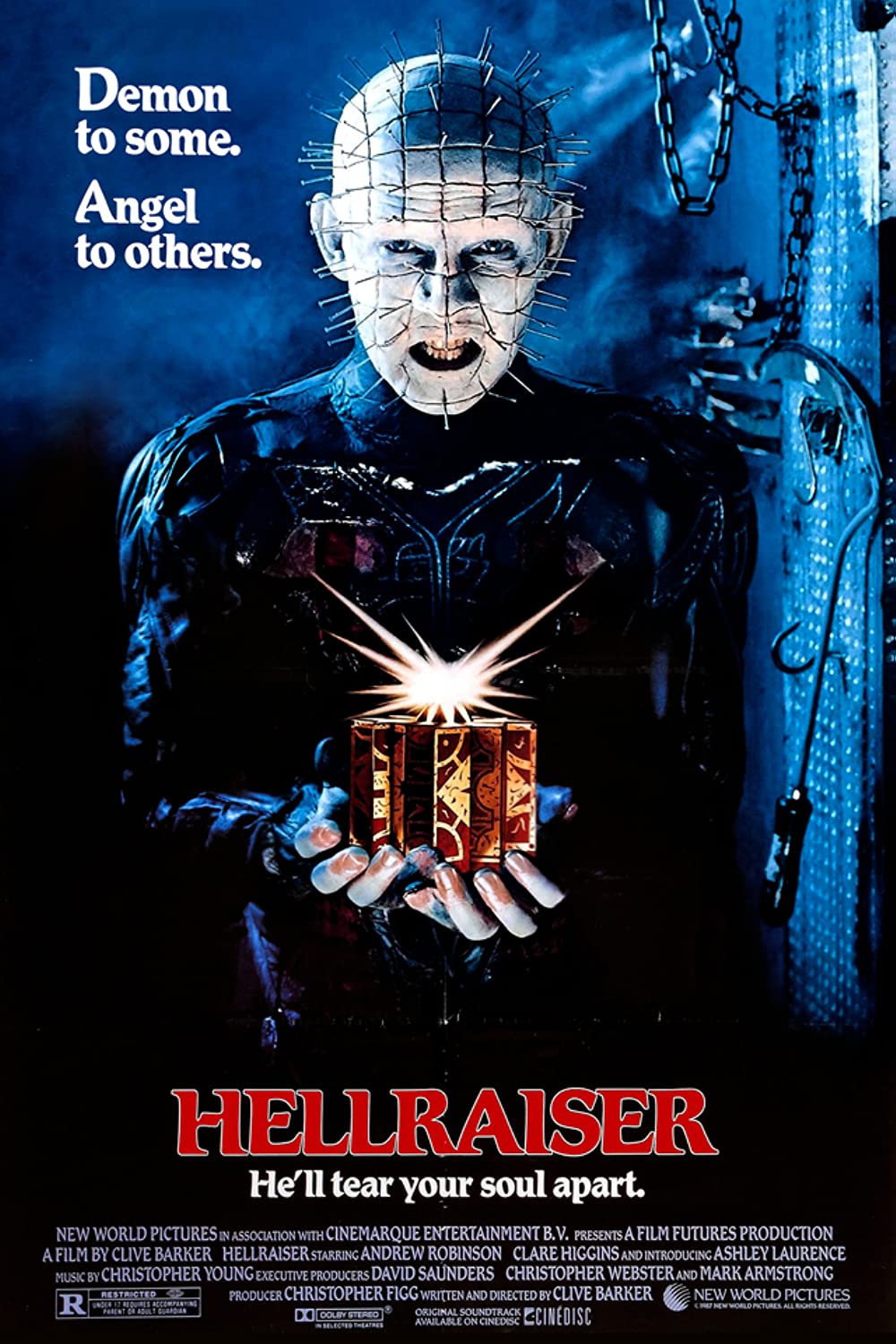
Scenes from a Marriage: Hellraiser at 35

Typically when a low budget horror film becomes a box office hit, it immediately spawns a wave of imitators. Movies like Night of the Living Dead and Halloween appear so easy to emulate (even if it proves deceptively difficult to actually do so) and the returns on their modest investments are so massive that their success initiates a rash of opportunistic copycats. That was not the case with Hellraiser, however. A low budget sensation in the tradition of other scrappy horror hits, it was so singular in its vision that it did not provide any ready made template for would-be imitators. Even trying to turn Hellraiser into a franchise has proved to be, at best, fitfully uneven. The thing is, there's just nothing else like Hellraiser. Even though there is an underlying mythology to it, it has not been easy to carry that mythology forward into other films and the experience that the original film provided has proved too elusive to duplicate. 

Released in the US on September 18th, 1987, Hellraiser saw writer Clive Barker finally taking the reigns of the movie adaptations of his work after the frustrating failures of Underground (1985) and Rawhead Rex (1986), with him writing and directing this adaptation of his novella "The Hellbound Heart." In stark contrast to the derision that Stephen King's efforts were met with when he stepped up to show 'em how it's done, directing the feature adaptation of his short story "Trucks" with 1986's Maximum OverdriveHellraiser was immediately greeted as a work of dark splendor. 

Depraved, disturbing, filled with unique, unsettling imagery, and wholly the product of its creator's vision, Hellraiser saw Barker showing the same command of the genre in film as he had in the literary world. The famous quote from Stephen King that trumpeted the arrival of Barker when Books of Blood was first published, "I have seen the future of horror and his name is Clive Barker" seemed to be proven all over again. There was a confidence to Hellraiser that marked Barker as not just a writer to watch but now a filmmaker too. 

Even though it was filmed under the grindhouse-y working title of Sadomascochists from Beyond the Grave, Hellraiser is as much devoted to charting the downward spiral of a failed marriage as it is to providing exploitation thrills. While the Hellraiser sequels put an emphasis on the anticipation of waiting for someone to start playing with the Lament Configuration and ring the dinner bell for the Cenobites, Hellraiser is more concerned with the broken marriage at its center and about the sick lengths a woman will go to for her lover. 

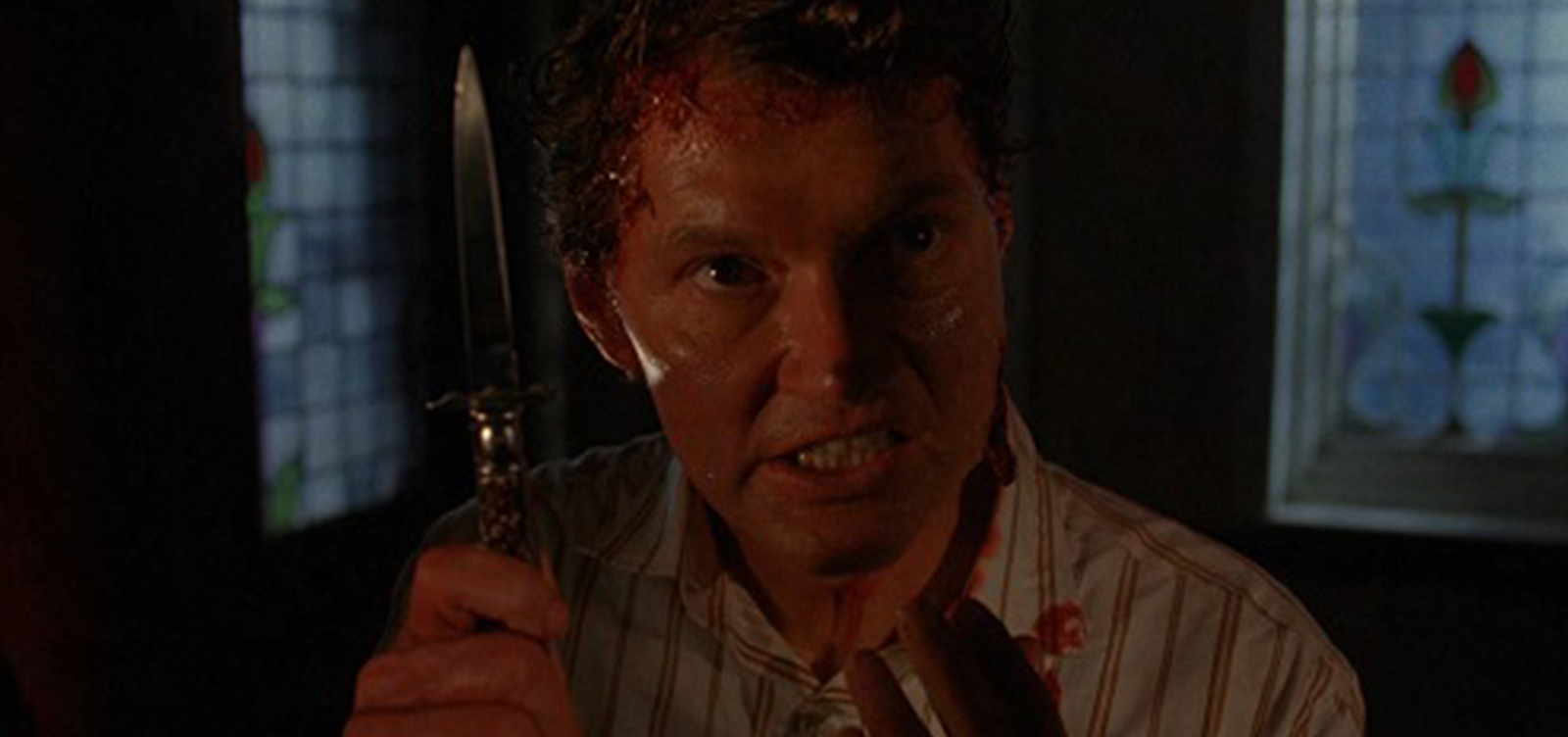
Even though Ashley Laurence as teenage Kirsty Cotton has the Final Girl role in Hellraiser, it's Clare Higgins as her (evil) stepmother Julia and Andrew Robinson as Kirsty's dad Larry, along with Sean Chapman as Larry's brother Frank, that drive the movie. Even the Cenobites are merely background players here to the drama between this unhappily married couple. We see Larry moving himself and Julia back into his long empty family home as Hellraiser begins, in the hopes that a new start will be the fix they need to repair their relationship.

As they settle in to their new digs in London (New World Pictures wanted American audiences to think that the movie takes place in the US but it's so unmistakably set in the UK), Larry is unaware that years earlier, just before their marriage took place, Julia had an affair with his brother Frank. 

Larry also doesn't know that Frank had purchased a puzzle box known as the Lament Configuration that, when used by Frank, invited those far out freaks known as the Cenobites to tear his flesh apart, sending Frank to hell. When Larry cuts his hand on a nail while moving a mattress upstairs, his blood splashes on the floor of the attic where Frank met his fate, leading to Frank to start his tortured journey back to the land of the living. 

Even though he's skinless, Julia's desire for Frank is undiminished. Frank tells her that he needs more blood to restore himself and before long, she is luring men to the house while Larry is at work and bludgeoning these poor saps with a hammer to soften them up for Frank. Sometimes she kills them out right, other times Frank jumps in to finish them off himself but in all cases, they're sucked dry by Frank (played in this form by Oliver Smith). 


Julia's afternoon murder sessions are contrasted with Larry's sad efforts to hang on to a marriage that he thinks can still be saved ("We can be happy here," Larry says to her early on as they prepare to move in to the new place). Larry could have easily been played as an object of derision, this oblivious, cuckolded man who can't satisfy his wife, but Robinson is able to make him sympathetic. While he is no doubt unhappy in his marriage himself, Larry is determined to stick it out and is earnest in his efforts to make it work. He isn't able to be the lover that Julia wants but, to be fair, Julia's needs are way out of Larry's range. He might be open to trying new things to spice up their marriage but he's never going to match Frank's game. He's not going to beat the bedroom moves of a guy who gets off on having his skin flayed by demons.  

For her part, Higgins is wonderfully wicked as Julia. It's one of those performances that, had it not been in a genre film would have received Oscar consideration. This could have easily been a one-note role but Higgins is able to make Julia more than just an evil bitch. While she isn't justified in her actions, Higgins is able to convey the lust and longing that drives her and her desire to be truly fulfilled. She will cross any line for Frank, with no care for the consequences. Larry's dogged loyalty to Julia will not spare him from a cruel fate.

Once Julia and Frank have not just disposed of Larry but Frank has inhabited his dead brother's skin, Hellraiser moves into its climatic third act and all the cards are turned over as Kirsty has come in contact with Frank's old party pals, the Cenobites and she has no hesitation in dropping a dime on Frank. As for the Cenobites, as imagined by Barker and brought to life by FX artist Bob Keen, they are just about the greatest ghoul gang in horror. What a sight they are. Their combination of elegant ghastliness and morbid beauty is unique to them. Right from the start, they were instantly iconic, with Doug Bradley's performance as the Cenobite Soon To Be Known As Pinhead conveying a real sense of majesty. The gravitas Bradley brought to his role made it clear that the Cenobites were not going to be jump scare monsters. They were going to simply arrive and command your attention, not lunge into the frame to startle you. Composer Christopher Young's score provided the perfect assist in that regard, with its lush romanticism.   

Usually movie monsters are kept hidden and only slowly revealed. Filmmakers keep them cloaked in darkness, show their shadows on the wall, reveal only fleeting glimpses. The strategy is to show as little as possible as long as possible and to let the audience fill in the details with their imagination. But Barker doesn't bother with that. He shows off his Cenobites with pure presentational flourish, letting us savor every (literal) pain-staking detail of their twisted but precise designs. And when these suckers finally get their hooks in Frank, oh my. 

As the restored Frank, Robinson's malevolence is pitch perfect (it's too bad he couldn't have returned to continue his villainy in Hellbound) and the moment of his comeuppance is an all-timer. Not just for the way that his head is ripped apart but more so for that unscripted last line of "Jesus Wept" that was entirely Robinson's suggestion. The way he savors these words as Frank's skin is pulled apart nails (pardon the expression) the character's devotion to pleasure through suffering.


Kirsty's subsequent escape from the Cenobites, as she sends them back to Hell one by one, is the closest Hellraiser comes to delivering conventional funhouse style thrills. Amusingly, the Cenobites aren't much of a real threat to Kirsty here. It's more a matter of Barker just wanting his Cenobites to linger on the stage a little longer and to give each of them a final curtain call. Pinhead is the first to leave the party (a clear indication of how little stock Barker put in his Lead Cenobite) and the only Cenobite that seems kind of dangerous, Butterball, is comically taken out by debris clonking him on the head just as he is about to bury a knife in the back of Kirsty's boyfriend Steve (Robert Hines). 

The real story that Barker was telling in Hellraiser was about Frank and Larry and Julia and once he brought that to its conclusion, everything after is just played for fun. To that end, Barker delivers a final scene of unfettered nonsense in which Kirsty disposes of the puzzle box in a trash fire burning in a vacant lot only to have the sinister vagrant that has been lurking on the periphery of the movie shamble forth to claim the box from the flames, catch on fire, and then turn into a horned, skeletal dragon and fly away. It is the greatest WTF ending to a horror movie since the Incubus came out of nowhere in Wes Craven's Deadly Blessing.

For a while after the release of Hellraiser (all the way until Nightbreed's release in 1990, really), Barker looked like a lock to join the esteemed ranks of Romero, Craven, Carpenter and Hooper as a modern Master of Horror but Barker's post Hellraiser directing career proved to be as doomed as Julia and Larry's marriage. The blame for that lies with incompetent studio execs rather than with Barker but whatever the cause, the end result was still that while he went on to make two more interesting, if flawed, films, Barker never fulfilled the directorial promise of Hellraiser. But man, what a movie it is. Thirty five years later it still has the ability to sink its hooks into viewers. 

Thursday, September 15, 2022

Is There A Barbarian In The House?


It's too bad that it stopped being fashionable to make horror titles out of negative imperatives because Barbarian would have been a prime candidate for that. Just as '70s fright fare like Don't Look in the Basement and Don't Open the Window (aka The Living Dead at Manchester Morgue) sought to alarm audiences before they even stepped into the theater with titles that promised dire consequences for anyone who did what they said not to do, Barbarian has a couple of important don'ts to offer. For starters, Don't rent an Airbnb and Don't go in to any unfamiliar basements. To get into even greater specifics, Barbarian is adamant that you Don't enter any hidden tunnels. Not even one step. Nothing good is ever at the end of them. The most important don't of all with Barbarian, though, is to Don't Miss It. This is one of the best horror films of the year.

The word on Barbarian is to go in to it knowing as little as possible. This suggests that this is some sort of twisty, M. Night Shyamalan construction with a whiplash inducing climatic revelation but it isn't. There is no big third act surprise that upends everything we've seen up to then. The bare bones of Barbarian, if you lay them all out, are actually fairly conventional. It will spoil no one's enjoyment if they know going in that there are hints of The People Under the Stairs and Castle Freak here. What makes Barbarian so thrilling is the choices that writer/director Zach Cregger (a founding member of the NYC-based comedy troupe The Whitest Kids U' Know) makes in telling his story. Full spoilers from here on out so Don't keep reading if you haven't seen Barbarian.

Barbarian begins with Tess Marshall (Georgina Campbell) arriving late on a rainy night to the home she's rented while she's in Detroit for a job interview only to find that a young guy named Keith (Bill Skarsgard) is already there. Tess and Keith went through different apps to rent the property and it has been inadvertently double booked. Cregger does nothing to tip his hand in this early stretch as to what is going on. Tess is understandably wary about Keith and while Keith is slightly awkward and jittery, we don't know if he's a threat to her. Their interactions and the gradual warming up that takes place between them has no hint of horror movie cues. We know that we've come to see a horror movie so something must be off but Cregger is counting on the audience, with no special prompting from him, to wonder for themselves where the danger lies. It shows his confidence as a filmmaker to have an extended opening to a horror movie where no horror is taking place and it is just two people talking and getting to know each other. 

The standard move with this movie would have been to start off with a grabber of an opening. According to formula, there should have been a pre-title sequence of a young woman arriving at the Airbnb and falling afoul, after a prolonged and suspenseful set-up, to some brutal attack. She screams, the title Barbarian slams onto the screen and then we see Tess arriving at the same place with on screen text reading, say, "Four Weeks Later." After having hooked the audience right away with a big scare, things could have taken a breather as Tess and Keith meet, knowing that the audience would still be buzzing from the opening, but Cregger does not do that. Not only does he not do that, he does not indulge in cheap jump scares or give any indication of what looming threat is out there or when it might strike. A lot of horror films are made with the belief that the audience will lose interest if they aren't constantly being pounced on by the filmmakers so the restraint that Cregger shows in this early stretch is admirable. 

The first act ends on a grisly cliffhanger but rather than immediately follow up on that and keep the momentum going, Cregger cuts to the introduction of Justin Long's character of actor AJ Gilbride. AJ is driving his convertible in the bright California sun when an incoming conference call delivers the news to him that an actress involved in the series he's working on has accused him of sexual assault. We stay with AJ and his story for a long time before we find out how he connects to Tess and Keith and to the Airbnb. Structurally, this is such an unconventional choice. Cregger places his main character in deadly peril at the end of Act 1, then abruptly leaves all that hanging to veer off into what feels like an entirely different movie, without a hint of horror. Now we suddenly find ourselves adjusting to a new storyline about an actor facing assault charges and losing his career. It's a jarring transition that forces us to pay attention and recalibrate because we know that this must connect somehow with what we've been watching up till now. On one level, this narrative shift gives the audience some relief because for the immediate moment it gets us away from the horror but yet on another level it only increases the tension because we know that we're not off the hook at all. Even though we've been transported to a sunny California road, we're inevitably only going to get dragged back into that house of horrors. The question is just a matter of how. 

When we discover that the Airbnb is a property that AJ owns and that he is going to stay there to get out of the shit storm consuming his life in LA, and to start selling his properties in order to keep money coming in, things start to come together. But even then, Cregger doesn't go the obvious route. Yes, AJ discovers that his property includes a series of hidden tunnels behind a secret door in the basement but rather than greet this discovery with a sense of dread or alarm, he immediately sees it as an opportunity to increase the value of his property by being able to list the additional square feet. This is one of the most inspired character bits in any movie, horror or otherwise, in I don't know how long. It's hilariously funny but entirely in character and it roots everything in identifiable, pragmatic, everyday reality. 

Before long, AJ's dreams of squeezing more value out of his property are gone because he's trapped in a pit with Tess, who we find is still alive, and the're both at the mercy of a psychotic, feral female that dwells in the tunnels under the house. But just as these two have finally come together and might be in a position to help each other, the action then cuts again to a back story that fills us in on how all the sick shit in this house came to be. Again, Cregger pulls the rug out from the viewers, forcing them to get their bearings. These sudden shifts in the story fly in the face of the relentlessness that horror films usually strive for. Cregger keeps bringing the audience to a climatic moment only to yank them away and force them to start over. It's these deliberately disorientating structural choices that make Barbarian so unique. 

When we do return to the present day, the final act continues to offer surprises right up until the end. Unexpected decisions are made, opportunities for rescue and assistance don't play out in obvious ways, and characters continue to surprise us. Tess and AJ both make choices that take the action in directions that are impossible to anticipate. Tess, by being far more altruistic at various turns than someone in her circumstances might be, and AJ by being self-serving but with the underlying question of whether redemption is a possibility for him. It was an inspired move to cast Justin Long, a naturally likable actor, as AJ so no matter what lines he crosses, it always seems plausible that he'll ultimately end up doing the right thing. And when outside forces like the police or a local vagrant are introduced, their involvement does not provide the automatic relief that we expect it to but the ways in which those hopes of assistance are dashed or defeated are unpredictable. 

The recent Bodies Bodies Bodies was a clever, genre-bending exercise that, for me, didn't quite deliver the goods. It was a movie where you could perceive and acknowledge the clear intelligence behind it but still feel shortchanged by the movie overall. Barbarian, on the other hand, is every bit as clever in how it subverts genre expectations but it also gives the exploitation crowd everything that they came for. Cregger knows that when it comes to horror, the bottom line is you've got to deliver. You can be clever as you want but you also have to know you're playing to a crowd wants to see, say, a dude getting beaten to death with his own severed arm. But yet as grueling as some of the content of Barbarian is, Cregger also maintains a sense of fun throughout with the film's more unsavory elements left largely to the imagination. There is a moment where AJ comes across VHS tapes whose hand-written labels tell us all we need to know to be chilled. No need to see their contents. And I guarantee that no one who watches Barbarian will ever look at a baby bottle the same way again.

For a first time horror director, Cregger shows a natural instinct for how to satisfy the commercial demands of the genre while also breaking from convention. We can immediately add his name to the current list of creators known for comedy who have shown an aptitude for horror. I only hope that, like Jordan Peele and David Gordon Green, Cregger will choose to stick around and make horror his home. What he's done with Barbarian is so fresh I have to imagine he's got much more up his sleeve. And I'm not talking about Barbarian 2

Sunday, September 11, 2022

Down the Dark Decades of Your Pain: Hellraiser III: Hell on Earth at 30

Hitting theaters in back to back years of '87 and '88, Hellraiser and its first sequel, Hellbound: Hellraiser II, are arguably the greatest one-two punch in '80s horror. Yes, a convincing case can also be made for the first two Evil Deads but I lean slightly towards that early pair of Hellraisers, two movies that brought a lurid and lascivious attitude (not to mention copious buckets of slime and gore) to the increasingly safe and sterile late '80s horror scene. It's when it become a trilogy is where Hellraiser ran into trouble. Hellraiser III: Hell on Earth, first released thirty years ago on September 11th, 1992, represented the Americanization of the staunchly British, and thus far bloody and baroque, series. Despite continuing to be guided by British talent, III was crafted to have a mainstream American vibe. With its action set in New York City (actually filmed in Greensboro, North Carolina with some establishing shots of Times Square and the Twin Towers included), Hell on Earth was designed to be a slicker, more pop orientated product, a fact that rubbed many fans of the first two films the wrong way. However, as a fan of the first two I was still enthusiastic for this newly commercialized brand of Hellraisin' and on the occasion of its 30th anniversary I continue to embrace this admittedly lesser sequel as a damn good time and as a nostalgic snapshot of early '90s horror. 
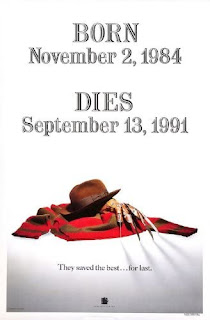
With a script by Hellbound: Hellraiser II writer Peter Atkins (sharing story co-credit with Hellbound director Tony Randel), Hell on Earth represented a big push to make Pinhead into a rock star. Freddy Krueger had been laid to rest in 1991's Freddy's Dead: The Final Nightmare and every other big horror icon was between sequels at the time, with the poor reactions to their previous outings having left them in limbo. In 1992, there was no Jason, no Michael Myers, no Leatherface, no Chucky. At that moment, everything was primed for Pinhead to go to the next level, with no competition. Initially, Pinhead had been just one of the gang in the original Hellraiser but the reaction to his striking look and to Doug Bradley's commanding performance caused his profile to be increased in Hellbound but Julia (Clare Higgins) was still very much the main villain of that sequel with even her wicked cohort and would-be lover Dr. Channard (Kenneth Cranham) having a stronger evil presence than Pinhead, to the point where Channard himself made quick work of Pinhead and his OG cenobites in their big face off. With Hell on Earth, though, it was very much Pinhead's show and this film was a concerted effort to take a big swing with him. Never again would Doug Bradley have so much screen time as Pinhead and also as his human alter ego of WW I vet Elliot Spencer. 
The road to Hell here, courtesy of Atkins' screenplay, is a somewhat convoluted one, involving several different players. When a funky stone pillar with an array of twisted, tormented faces carved into it (including the trapped Pinhead) catches the eye of twentysomething Goth girl Terri (Paula Marshall) at an art gallery, she gives her boyfriend J.P. Monroe (Kevin Bernhardt), owner of the hot nightclub The Boiler Room, a heads up about this piece that might suit his morbid tastes. Sure enough, this Pillar of Souls (last seen at the end of Hellbound) is totally J.P.'s thing and the mysterious owner of the gallery is happy to sell it to J.P. at whatever price J.P. is ready to pay. Once the statue arrives at the Boiler Room, a club attendee with sticky fingers discovers it and pries the tempting prize of the Lament Configuration loose from its stone surface. After futzing with the box he soon finds his flesh embedded with hooks and chains in classic, super painful Hellraiser fashion.  
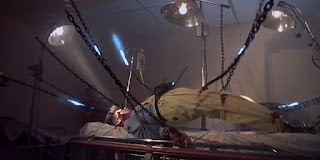
It's at this point that we and III's heroine (Terry Farrell as up and coming TV reporter Joanne "Joey" Summerskill) come into the action. The backstory of the thief separating the puzzle box from the pillar is an off-screen incident that Terri relates to Joey afterwards. At first we and Joey are plunged into the chaos of the thief being hastily wheeled into the ER with chains pulling his body apart. Having been assigned by her station to cover the action at the normally busy ER, Joey was in the middle of cursing the night's uncommon lack of incident (it's so uneventful her cameraman has to leave to cover breaking news elsewhere) when this victim suddenly bursts through the ER doors on a stretcher, bloody chains dragging behind him. Within seconds, his head explodes in a burst of gory glory and Joey's keen reporter instincts kick in to tell her that, hey, there just might be a story here. 

Terri had accompanied the victim to the hospital but fled soon after but not before she uttered the words "Boiler Room" to Joey. Soon, Joey has figured out that the Boiler Room is a downtown club and she makes her way there to question the aloof, arrogant J.P. and seek out Terri for answers. Needing a place to crash after J.P. breaks up with her and kicks her out, Terri agrees to help Joey in her investigation if she will put her up at her place. Soon the two ladies find themselves bonding (one of the strengths of III is the gal pal chemistry between Farrell and Marshall) and uncovering answers, like the origin of the Pillar of Souls and of the box that was embedded in it.   
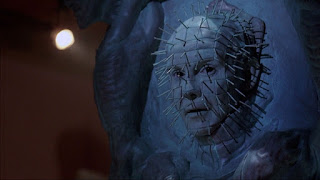
Meanwhile, back at J.P.'s pad within the Boiler Room, his newly added room decor is starting to talk. J.P. had reached his hand into the open space where the Lament Configuration had been only to be bitten by a rat hiding inside. He drew his hand out and the blood from his wound splashed on the pillar and was quickly absorbed, awakening Pinhead. Of course Pinhead needs to absorb much more blood to completely extricate himself from the pillar and for that he's going to need his new boy J.P.. Turns out this trust fund kid is even more vile than just the garden variety douchebag he comes across as. Apparently he killed his wealthy parents in order to gain their fortune so, as you can imagine, it doesn't take much convincing from Pinhead to get J.P. on board with doing evil shit. What Pinhead doesn't tell him is that this new partnership is a one way ticket to Hell.
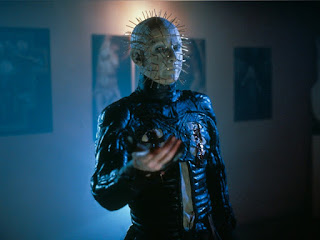
Before long, Pinhead is back in fighting form and J.P., along with the unfortunate Terri, the DJ at the Boiler Room, its bartender (played by writer Peter Atkins), and Joey's loyal cameraman, find themselves unwillingly recruited into forming Pinhead's fresh n' funky Class of '92 posse.

These new cenobites are quite a crew. If you're ok with the style these guys are rocking, you can get on board with this movie no problem. If you happen to think a CD Head or Camerahead cenobite just look stupid however, well, it's probably going to make it tough to warm up to Hell on Earth. I do agree this is a very silly bunch, not at all in the league of the truly bizarre and unsettling cenobites of the original. In contrast, these guys are like the Hot Topic Cenobites. They're not so much a representation of dark desires as of poor life choices. When you have a cenobite that's whipping deadly CD's through the air like ninja stars or breathing fire like Gene Simmons at a KISS concert, you just have to accept that this is a very different style of Hellraiser movie. 
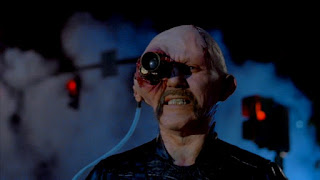
To clarify, it's the kind of Hellraiser where they give the cenobites one-liners like "...That's a wrap!" I can't argue with anyone who finds that to be an intolerable offense but, for myself, I find it to be enjoyably goofy. I mean, at one point Barbie Cenobite does his finest Kool-Aid Man impression by entering a scene by bursting through a brick wall. It's just pure '90s ridiculousness. Now, had they made a joke of Pinhead himself, that would have been another story, that would have been a deal breaker, but they definitely don't. He may be presiding over a bit of a clown show at times but he always maintains his gravitas. When he's single-handedly orchestrating a slaughter of everyone at the Boiler Room, it's hardcore by '90s standards. And as cut rate as these new cenobites may be, they're well suited to the action orientated approach of Hell on Earth. You can't imagine the OG cenobites having a big showdown with the police in the middle of a city street but these guys are tailor made for it. They came ready to party.


Hell on Earth director Anthony Hickox was one of the busier genre directors of the late '80s/early '90s and his output - including Waxwork and Sundown: The Vampire in Retreat - remains some of the most entertaining of the decade. Hell on Earth was his most high profile film, the rare one to be granted a wide theatrical release rather than a direct-to-video one, and he did a bang up job of making this an unabashedly commercial sequel. The entire final act of Hell on Earth is a splashy action extravaganza that would not have been at home in either of the previous Hellraisers but Hickox goes for it with explosions galore as Joey flees from Pinhead and the new cenobites. It's the kind of extended final chase typically seen in slasher movies where the Final Girl is pursued after every one else has fallen to Jason or Michael but here it's Pinhead relentlessly pursuing Joey through the streets of NYC, siccing his new goon squad on her and on anyone who stands in his way, whether it be the cops or the priest that Joey encounters in a church she tries to take refuge in. There's never been a sequence like it in any Hellraiser before or since, with the action continually escalating beat by beat in an almost relentless Terminator-esque fashion. It goes big in a way that Hellraiser never attempted again.
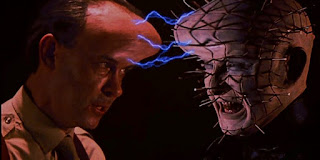

The turn towards spectacle may have felt like a sell out move to many but it should be said that, at the time, the more straightforward, streamlined, audience pleasing approach of Hell on Earth was seen by some as an improvement over the muddy metaphysics of Hellbound. Also bolstering the excitement factor of Hell on Earth was the fact that this was the first entry in the series to feature CGI. As much as we've come to take CG for granted, it was still a novel new FX tool in '92. With the game-changing technology initially only exclusive to blockbusters like The Abyss and T2: Judgement Day, it was cool in '92 to see it first start to appear in the likes of Children of the Corn II: The Final Sacrifice, Sleepwalkers, and Hell on Earth. It was genuinely eye-catching to see glimpses of CG in the trailers and TV spots for these films because it was a look were weren't jaded to yet. It was a fresh sight, especially in low budget horror. CG wasn't always an ideal fit with horror but used sparingly, it worked well in Hell on Earth and at the time it gave it the state of the art sheen of a new era. 


By the early '90s, the halcyon days of the '80s had passed and the genre was largely out of favor with the studios so when a horror film actually got a theatrical release back then it was notable. I tend to have fond memories of pretty much all the horror movies that hit theaters then because they were so few and far between. And when you had one that really strove to deliver a good time and be a straight up crowd pleaser in the way that Hell on Earth did, that was all the better. 


I cheered Hell on Earth all the way through, right to its final frames where it's revealed that the new building built on the spot where Joey disposed of the puzzle box in the wet cement of a construction site has somehow been designed in the style of the Lament Configuration. How that happened exactly, I don't know and I don't think anyone involved in the movie does either but damn if it didn't look cool. Bottom line, I felt very satisfied when the end credits rolled on Hell on Earth. Pumped, even. It was one of the best horror rides of the year and it felt like the Hellraiser franchise had been newly energized for the '90s. It wasn't a long lived feeling but it was nice while it lasted.  
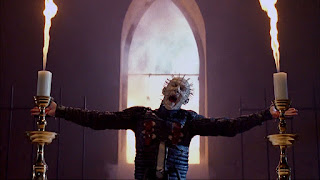
At one point during Hell on Earth's climax, as Pinhead's new crew surrounds Joey, he taunts her with the promise that "down the dark decades of your pain, this will seem like a memory of heaven." Thirty years later, I have to say those words weren't entirely wrong. It may not be the sort of nostalgia that Pinhead was talking about but it's still true to say that Hell on Earth endures as a fond memory for fans who were there to enjoy it back in the day. It glows with the aura of a simpler, more innocent time and that in itself is heavenly enough.